

Yes, you can place a reclining sofa against a wall, but the answer depends on the reclining mechanism, how the backrest moves, and how much recliner clearance the sofa requires.
A traditional recliner usually needs open space behind it because the backrest travels backward as it reclines. A wall-hugger or zero-wall design is different: its frame is engineered to move the seat forward while the backrest reclines, allowing it to sit much closer to the wall. In this guide, you will learn how to tell which type you have, how much space to leave in inches and centimeters, how to measure your room before buying or positioning a sofa, and how to protect your walls, floors, cables, children, and pets.
The goal is simple: find the minimum safe clearance first, then make the sofa fit the room safely.

Chenille Power Reclining Sofa - Homary
Table of Contents
Can a Reclining Sofa Go Against a Wall? The Short Answer + 4 Rules to Check First
A reclining sofa can go near a wall, and in some cases it can sit very close to one. However, “close to the wall” is not automatically the same as “flush against the wall.” The correct position is determined by the sofa’s movement and installation requirements.
Use these four rules before deciding where to place it:
Rule | What to check | Why it matters |
1. Identify the mechanism | Manual, standard power, or zero-wall/wall-hugger | Each type uses a different movement path |
2. Watch the backrest and seat | Does the back move backward, or does the seat travel forward? | Backward movement creates a larger rear clearance |
3. Check cables and outlet access | Power cord, transformer, outlet, and cable path | A sofa may need space for safe connection and inspection |
4. Read the manufacturer’s instructions | Look for a stated minimum wall clearance | This is the most reliable requirement for that specific sofa |
Manual reclining sofas use a lever or body-weight mechanism, while standard power recliners use a motor. Both may still send the backrest backward.
Zero-wall and wall-hugger designs work differently. Their mechanisms allow the seat or internal frame to move forward as the back reclines. This greatly reduces the rear space needed, but it does not always mean the furniture should physically touch the wall.
The manufacturer’s stated minimum clearance should always take priority over a general rule of thumb. A sofa can look safely positioned upright but still strike the wall when fully reclined.
How Much Clearance Does a Recliner Actually Need?
There is no single universal clearance number because reclining mechanisms vary by frame design, back angle, seat travel, and upholstery construction. Still, useful planning ranges can help you judge whether your room is likely to work.
For a typical furniture layout, use the following as a starting point rather than a substitute for the sofa’s instructions:
Reclining type | Typical rear clearance to plan for | Approx. in cm | General planning note |
Manual rocker/recliner | 6–12 in | 15–30 cm | Usually needs room for the backrest to travel |
Standard power recliner | 5–12 in | 13–30 cm | Motorized operation does not automatically mean wall-hugging |
Zero-wall / wall-hugger | 0–5 in | 0–13 cm | Designed to minimize rear movement; verify the model’s requirement |
These ranges are best treated as practical planning estimates. Some designs will require more space, while compact mechanisms may require less. Reclining sofa frames can also behave differently from single-seat recliners, especially when multiple seats share a frame or console.
Manual reclining sofas
A manual recliner often has a noticeable rear arc. As the backrest moves from upright to fully reclined, the top of the back can travel toward the wall. A planning allowance of about 6 to 12 inches (15 to 30 cm) is a reasonable starting range when the exact requirement is unknown.
Rocking recliners deserve extra attention because their motion can involve both rocking and reclining. Even when the main backrest movement seems modest, the base may shift slightly during use.
Standard power recliners
Power operation changes how the mechanism is activated, not necessarily how much space the backrest occupies. A standard power recliner may still require roughly 5 to 12 inches (13 to 30 cm) behind the furniture.
Do not assume that a powered sofa can be pushed directly to the wall simply because there is no manual lever. The critical question is still: where does the backrest go when fully reclined?
You also need to account for the electrical setup. A power sofa may have a cord, power supply, or connection point that should remain accessible and free from crushing or sharp bends.
Zero-wall and wall-hugger designs
A wall-hugger or zero-wall recliner is designed to reduce the rearward movement of the back. Instead, the seat travels forward as the chair reclines. Depending on the design, the sofa may need only a small gap behind it.
Some products are designed around an especially small rear gap, but “zero-wall” does not always mean zero contact. A small gap may still be needed for the mechanism, upholstery, wall protection, or cleaning access.
What if you do not have the manual?
If you cannot find the instructions, do not make a permanent placement decision based only on the upright position.
Start with the larger end of the planning range for its mechanism type. Leave extra room, recline the sofa fully, and inspect the entire path from the top of the backrest to the wall. Also check whether the sofa moves forward during operation.
A simple field test uses a tape measure and a second person. Mark the wall position, measure the upright gap, then operate the recliner fully. Watch the top rear corners as well as the sides of the frame. The smallest gap reached during the complete movement is the clearance that matters.
Painter’s tape on the wall can also mark the safe position and make movement easier to spot.
Once you know the typical numbers, the next step is applying them to your actual room.
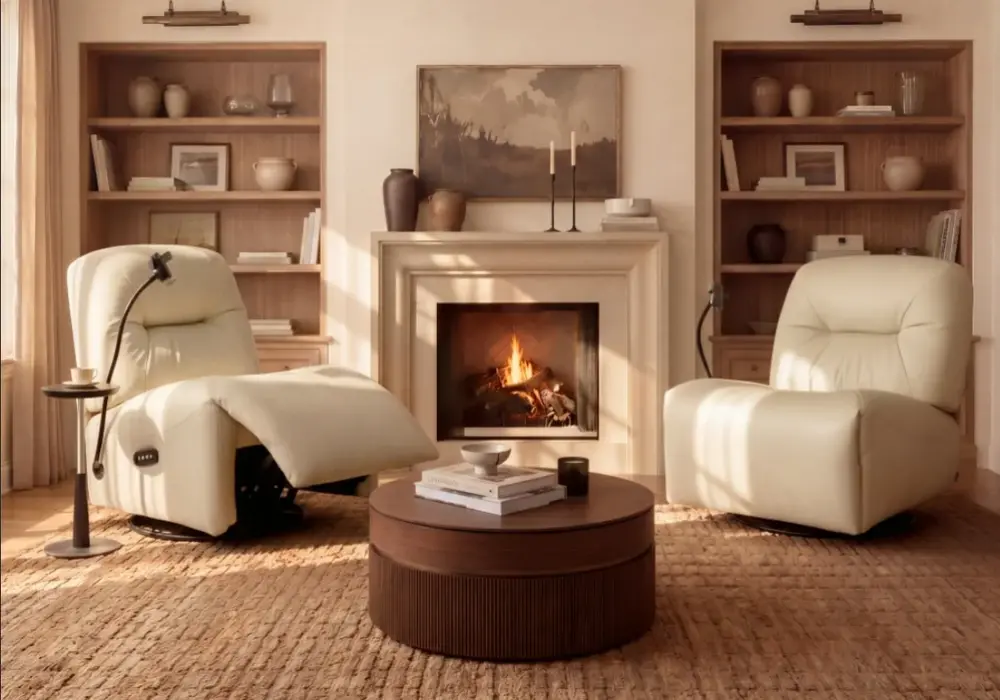
Genuine Leather Power Swivel Rocker Recliner - Homary
Step-by-Step: Measuring Your Space Before You Buy or Place a Recliner
The safest approach is to measure the room for the sofa’s full movement, not just its closed footprint.
Measure the total usable length
Measure from the wall behind the sofa to the point where the sofa’s front edge can extend without blocking a doorway, walkway, table, or another piece of furniture.
Do not measure only the sofa’s advertised depth. The closed depth and fully reclined footprint can be very different.
If you are planning a reclining sofa with a console or multiple seats, measure the total width as well. Check both ends of the sofa because side clearance can matter when reclining seats operate independently.
Calculate the maximum recline arc
The “recline arc” is the area the sofa occupies as it moves from upright to fully reclined.
Start by measuring the sofa depth in its upright position. Then, with the sofa in your room, measure the distance from the wall to the front-most point when fully reclined. The difference between those two positions gives you a practical picture of how much additional floor depth the movement requires.
For a new purchase, use the listed fully reclined depth when available. If it is missing, use a similar mechanism as a rough estimate and leave a safety margin.
Check the floor, baseboards, and wall shape
Floors are not always perfectly level. A thick rug, transition strip, uneven subfloor, or plush carpet can slightly change how a reclining frame sits.
Baseboards matter too. A thick baseboard can push the lower frame farther into the room even when the upper backrest appears close to the wall. Measure from the actual contact point, not from the wall surface above the baseboard.
Also inspect windowsills, heating grilles, trim, and other projections.
Confirm the outlet and cable position
For a power reclining sofa, identify the closest suitable outlet before final placement. Check where the cord exits the furniture and whether the plug can be inserted without being crushed against the wall.
Avoid routing cables under moving parts or across the sofa’s mechanism. The cord should have enough slack for normal movement but should not form a loose loop where feet, vacuum cleaners, or pets can catch it.
Zero-Wall & Wall-Hugger Recliners: How They Work and Who Should Choose Them
When a traditional reclining sofa cannot fit because there is not enough room behind it, a zero-wall or wall-hugger recliner can be a practical solution. These recliners are designed to reduce the amount of rear clearance needed, making them especially useful in compact living spaces.
How Does a Zero-Wall Recliner Work?
A zero-wall recliner uses a specialized mechanism that changes how the seat and backrest move. Instead of simply pushing the backrest backward, the seat moves forward as the back reclines. This allows the sofa to maintain most of its movement within the usable area in front of the wall.
The design can significantly reduce the amount of space required behind the sofa compared with a conventional reclining mechanism. However, “zero-wall” does not necessarily mean that the sofa should physically touch the wall. A small gap may still be necessary to allow the mechanism to move freely and prevent the upholstery or frame from rubbing against the wall.
What Makes Wall-Hugger Recliners Space-Saving?
The main advantage of a wall-hugger recliner is its smaller rear footprint. A standard recliner may need several inches of clearance behind the backrest, while a wall-hugger design can often be positioned much closer to the wall.
This makes these recliners a useful choice for apartments, narrow living rooms, rooms with large windows, and multifunctional spaces where every inch of floor space matters. By reducing rear clearance, they can also leave more room for walkways and other furniture.
Who Should Choose a Wall-Hugger Recliner?
A zero-wall design is best suited to homeowners who want reclining comfort but have limited space behind the sofa. It can be particularly helpful when a traditional recliner would block circulation or require a major furniture rearrangement.
However, space-saving should not be the only consideration. Because the seat moves forward during reclining, the seating position and leg support may feel different depending on the user’s height and preferred posture. You should also check the sofa’s forward extension to make sure it does not interfere with a coffee table, walkway, or nearby furniture.
Before choosing one, measure both the required rear clearance and the full reclined footprint. The ideal wall-hugger is one that fits the room without compromising comfortable, unrestricted movement.
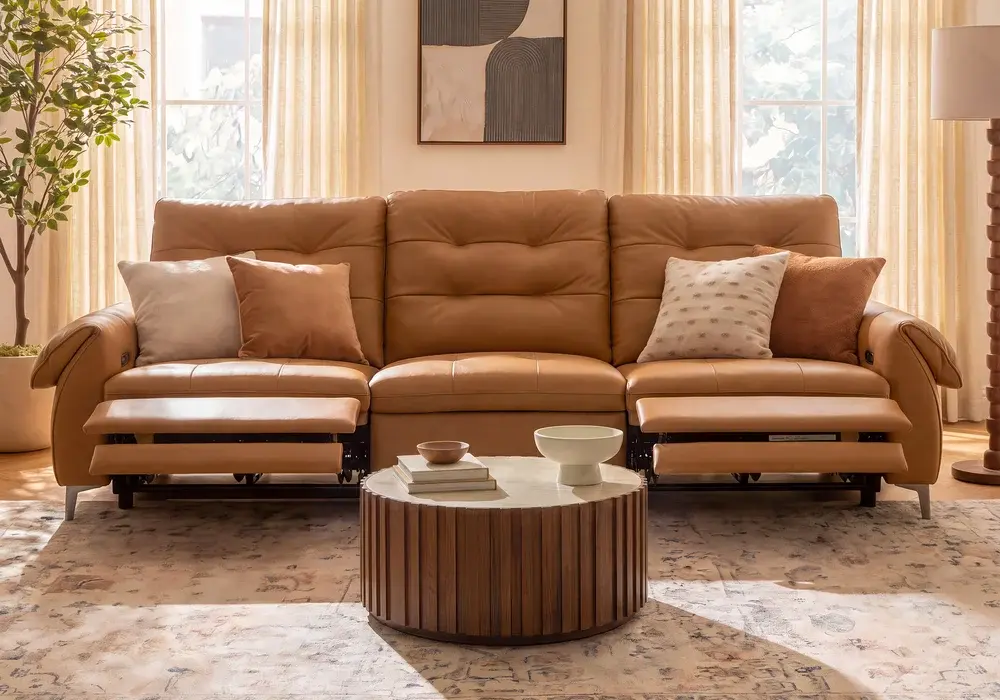
Genuine Leather Power Reclining Sofa - Homary
Protecting Walls, Floors, and Family: Practical Fixes and Safety Tips
Once your sofa is correctly measured and placed, a few inexpensive protective measures can prevent small clearance problems from turning into visible damage.
A wall protection pad or soft wall bumper can reduce light contact at vulnerable points. For homes with substantial baseboards, a baseboard guard can help prevent repeated rubbing or scuffing. On hard floors, non-slip furniture pads can reduce unwanted movement, especially when the sofa reclines repeatedly.
Cable clips or cord-management clips can keep a power cord routed neatly along a safe path. Keep the cable away from moving parts, pinch points, and walkways.
Problem | Practical fix |
Wall scuffs | Soft wall bumper or protective pad |
Baseboard rubbing | Baseboard guard or small protective strip |
Sofa shifting | Non-slip furniture pads suitable for the floor |
Loose power cable | Cable clips and a clear cable route |
Safety matters most around moving furniture. Recliners have pinch points where seats, footrests, linkages, and frames come together. Keep children and pets away from the moving mechanism, and teach children not to play under or behind the sofa while it is operating.
Make sure the sofa sits securely. Never overload the footrest or use it as a step.
For powered models, inspect the cord periodically for wear, crushing, or loose connections. Keep the plug and connection points accessible enough for inspection, and follow local electrical safety requirements for installation and use.
Every few months, check the rear clearance, inspect walls and baseboards, remove accessible dust and debris, and follow the upholstery care instructions. Furniture can shift after rugs are added or layouts change.
FAQ
Can a reclining sofa sit flush against a wall, or do I always need clearance?
Not always. A conventional manual or standard power recliner normally needs rear clearance because the backrest travels backward. A zero-wall or wall-hugger design may need only a very small gap, but it should still be positioned according to its stated minimum clearance.
How much clearance do power recliners vs. manual recliners typically need?
As a general planning range, manual reclining sofas often need about 6–12 inches (15–30 cm), while standard power recliners may need about 5–12 inches (13–30 cm). The actual requirement depends on the mechanism, so the manufacturer’s specification should take priority.
How do I measure the recline arc so I know my sofa will fit?
Measure the distance from the wall to the sofa’s front-most point when upright, then repeat the measurement with the sofa fully reclined. The fully reclined position determines the maximum floor depth needed. Test the complete motion, not just the starting and ending positions.
What is a wall-hugger or zero-wall recliner, and does it really let the sofa touch the wall?
It is a recliner designed to move the seat forward as the backrest reclines, reducing rearward movement. It can sit much closer to a wall than a traditional recliner, but “zero-wall” does not automatically mean the frame should touch the wall. Check the required gap for the specific design.
How can I protect my walls, baseboards, and flooring from a reclining sofa?
Use soft wall protection pads where appropriate, protect vulnerable baseboards, and use non-slip furniture pads that are compatible with your flooring. The most important protection, however, is maintaining the correct clearance so the moving frame does not repeatedly rub against fixed surfaces.
What cable-management options work best for power recliners near a wall?
Use low-profile cable clips or cord guides to keep the power cord along a stable, protected route. Leave enough slack for normal sofa movement, but never let the cable run through the mechanism or become trapped beneath moving components.
What child- and pet-safety precautions matter most for recliners placed close to a wall?
Keep children and pets away from the moving parts, especially while the sofa is opening or closing. Check for pinch points, keep the floor around the sofa clear, and make sure cords cannot be pulled, chewed, or caught in the reclining mechanism.