

Choosing the right coffee table size can be surprisingly difficult. A table that looks perfect in a showroom may feel oversized in a small living room, while a table that seems spacious online can look lost in front of a large sectional. The reason is simple: there is no single “standard” coffee table size that works for every home.
The right dimensions depend on your sofa, room size, seating arrangement, rug, and the amount of space you need for walking around the furniture. Height matters just as much as length and width because the table should feel comfortable to use without sitting noticeably higher than your sofa seat.
This coffee table size guide covers standard dimensions, shape and placement, ideal height, small-space solutions, and how materials and budget can influence your choice. All measurements are given in both inches and centimeters to make the guide useful for readers around the world.
By the end, you will be able to measure your own space and choose a coffee table size with confidence.

Sculra 28" Round Walnut Coffee Table of Homary
Table of Contents
Standard Coffee Table Dimensions in Inches and Centimeters
Coffee table dimensions vary widely, but most residential designs fall within a few practical ranges. The first thing to consider is the table’s overall footprint: length and width for rectangular and square tables, or diameter for round designs.
Rectangular coffee tables
Rectangular tables are the most common choice because they work naturally with standard three-seat sofas and many sectionals.
Typical dimensions include:
- Small: 36–42 in long × 18–24 in wide (91–107 × 46–61 cm)
- Medium: 42–54 in long × 20–28 in wide (107–137 × 51–71 cm)
- Large: 54–60 in long × 24–30 in wide (137–152 × 61–76 cm)
For many homes, a 42–54 inch (107–137 cm) long table is a safe default in front of an average sofa. It provides enough surface area for drinks, books, and décor without dominating the seating area.
Square coffee tables
Square tables are particularly useful with sectionals, symmetrical seating arrangements, or larger living rooms.
Common sizes are:
- Small: 30–36 in square (76–91 cm)
- Medium: 36–42 in square (91–107 cm)
- Large: 42–48 in square (107–122 cm)
A square table works best when you have roughly equal seating on multiple sides. It can feel awkward in front of a narrow sofa because its depth consumes more floor space than a rectangular table.
Round and oval coffee tables
Round tables are excellent for improving visual flow and softening rooms filled with straight lines. Typical round table diameters are:
- Small: 30–36 in diameter (76–91 cm)
- Medium: 36–42 in diameter (91–107 cm)
- Large: 42–48 in diameter (107–122 cm)
Oval tables generally fall around 42–60 in long × 24–30 in wide (107–152 × 61–76 cm).
A round or oval coffee table is often a particularly good choice for compact rooms because there are no sharp corners extending into walking paths.
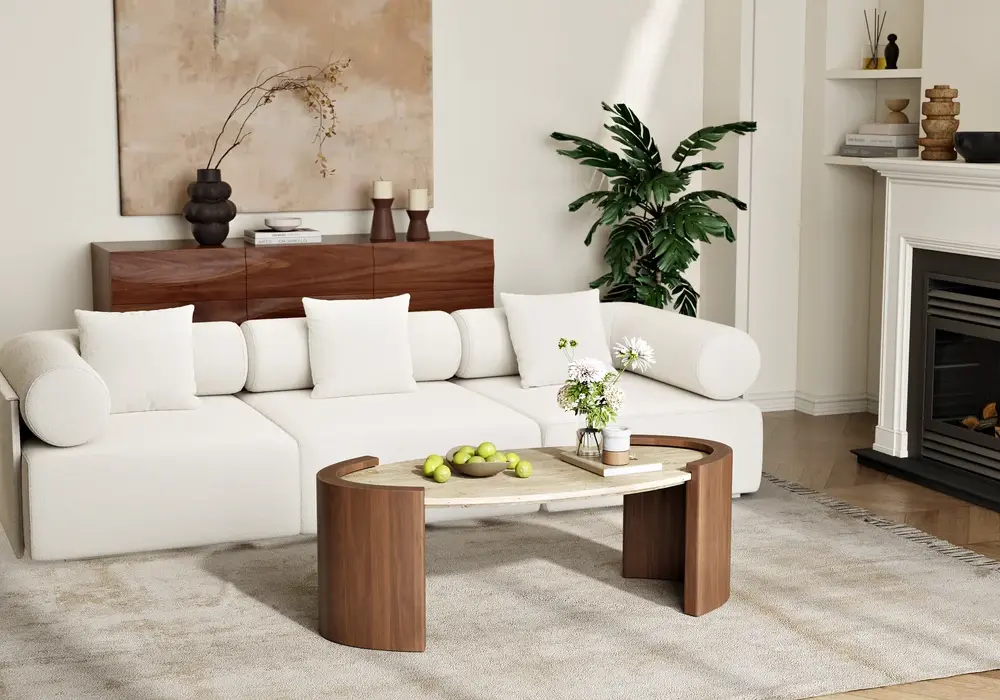
Japandi Oval Travertine Stone Top Coffee Table of Homary
Coffee table size by room and sofa depth
Living room | Suggested table size | Typical sofa depth |
Small | 30–42 in / 76–107 cm | 32–36 in / 81–91 cm |
Medium | 42–54 in / 107–137 cm | 36–40 in / 91–102 cm |
Large | 54–60 in / 137–152 cm | 38–42+ in / 97–107+ cm |
These ranges are starting points, not strict rules. A large room can still use a smaller coffee table when the seating arrangement is intentionally minimal, while a compact room may accommodate a larger table if the surrounding furniture has a slim profile.
As a general rule, the coffee table should visually relate to the sofa without overwhelming it. A useful default is to choose a table approximately two-thirds the length of your sofa. For example, an 84-inch (213 cm) sofa can often pair well with a table around 54–56 inches (137–142 cm) long.
The safest approach is to measure before shopping rather than relying on a standard size alone.
Shape and Placement: Matching Your Sofa, Rug, and Room Flow
Once you know the approximate size you need, shape and placement determine whether the coffee table will actually work in the room.
Match the table shape to your seating arrangement
A rectangular coffee table is a natural choice for a single straight sofa. It follows the sofa’s horizontal lines and provides convenient access from multiple seats.
A round or oval table works well with sofas that have curved arms, smaller seating groups, or rooms where you want easier movement around furniture. Curved edges are also useful when people regularly walk through the space.
For an L-shaped sectional, a square, rectangular, or round coffee table can work. The key is to make sure the table is centered within the seating area rather than pushed too far toward one end of the sectional. Round tables are particularly useful when you want access from several seating positions.
With two facing sofas, a rectangular table often creates the strongest visual balance. A square table can also work in a generously sized room.
Leave enough clearance around the table
One of the most important coffee table dimensions is not the table itself but the empty space around it.
A good starting point is approximately 16–18 inches (41–46 cm) between the edge of the coffee table and the sofa. This gives enough legroom while keeping the table close enough to reach comfortably.
For a primary walkway, aim for at least 24 inches (61 cm) of clearance. Where the space is frequently used or forms a major path through the room, 30–36 inches (76–91 cm) can provide a more comfortable traffic flow.
You should also consider the relationship between the coffee table and the rug. Ideally, the table should sit comfortably within the rug, with the rug extending beyond it far enough to visually connect the seating.
For many living rooms, a rug extending at least 12–18 inches (30–46 cm) beyond the coffee table helps create a cohesive seating zone. In larger rooms, the rug can extend under the front legs or all legs of surrounding furniture.
Coffee Table Height: Matching Your Sofa
Coffee table height is just as important as length and width. A table that is too tall can feel awkward and obstruct the view across the room, while a table that is too low may be uncomfortable for everyday use.
The most reliable rule is simple:
Your coffee table should usually be about the same height as your sofa seat or slightly lower.
Most sofas have seat heights around 17–20 inches (43–51 cm). Many coffee tables therefore fall in the range of approximately 16–18 inches (41–46 cm), although contemporary low-profile designs may be lower.
A practical target is to keep the coffee table within about 1–2 inches (2.5–5 cm) of the sofa seat height, generally on the lower side.
How to measure your sofa
You do not need special equipment. Sit the measuring tape on the floor and measure vertically to the top surface of the seat cushion.
For example, if your sofa seat is 19 inches (48 cm) high, a coffee table around 17–19 inches (43–48 cm) would normally be a comfortable range.
Also consider the sofa arm height. A coffee table should not feel disproportionately high compared with the surrounding furniture. However, the seat height is the more important measurement because that is the height your body interacts with most often.
Adjust the height for different sofas
A low-profile sofa may look best with a table around 14–16 inches (36–41 cm) high.
A standard sofa often works well with a table around 16–18 inches (41–46 cm) high.
Recliners and unusually tall sofas may require a slightly taller table, especially when the furniture is designed for easier sitting and standing.
Households with older adults may also benefit from choosing a table that is not excessively low. A slightly higher surface can make reaching drinks, books, or remotes easier without compromising the overall proportions of the room.
When in doubt, match the table to the sofa seat rather than choosing a height based only on the table’s appearance in a photograph.
Sizing for Small Spaces, Sectionals, Kids, and Pets
Small living rooms require more careful planning because every inch of floor space matters.
A round coffee table around 30–36 inches (76–91 cm) can work well in a compact seating area. Its curved edge makes it easier to move around than a similarly sized square table.
Another useful option is a narrow rectangular table, perhaps around 36–42 inches long × 18–22 inches wide (91–107 × 46–56 cm). This gives you useful surface area without consuming excessive depth.
Nesting tables
Nesting tables are one of the most flexible choices for small homes. Two or three smaller tables can be separated when you need extra surface area and stacked when you want a smaller footprint.
For example, a nesting set with individual tables around 16–24 inches (41–61 cm) wide can provide more flexibility than a single large table.
Lift-top and storage coffee tables
A lift-top table can be useful in a compact home where the coffee table also serves as a work or dining surface. The footprint may be similar to a conventional table, but its functionality can reduce the need for another piece of furniture.
Storage-top or compartment coffee tables are another space-saving option. They may allow you to store blankets, remotes, books, and other everyday items without adding cabinets to the room.
For homes with children or pets, prioritize rounded corners and softened edges. A round or oval table can eliminate sharp corners altogether. If you choose a rectangular or square design, look for gently rounded corners or use appropriate edge protection.
For families, height matters too. A lower table may be convenient for children but can be less comfortable for adults. Aim for a practical height that works for the primary users rather than choosing an unusually low table simply because the room is small.
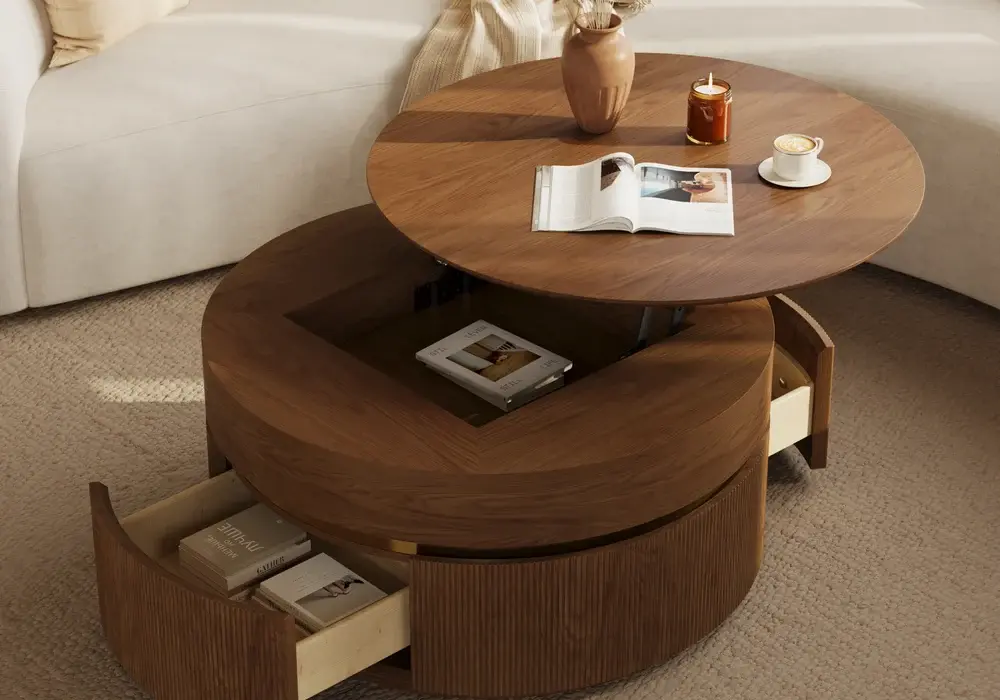
Fluted Lift-Top Round Walnut Coffee Table of Homary
Materials and Budget: How They Affect Size Choices
Material can influence how large a coffee table feels, even when the actual dimensions are identical.
Glass and metal tables often have slimmer visual profiles, making them useful in smaller rooms where you want the furniture to feel lightweight. A glass top can allow more of the floor and rug to remain visible.
Solid wood tables tend to have more visual weight and can make a strong statement in larger rooms. Thick legs, chunky tops, and substantial construction can make an otherwise moderate-sized table feel much larger.
Budget also tends to increase with size. As a rough guide:
- Entry-level: approximately $75–$250
- Mid-range: approximately $250–$800
- Premium: $800 and above
These ranges vary considerably by brand, material, construction, and market. Larger solid-wood or custom tables can cost substantially more than smaller mass-produced pieces.
Rather than paying for the biggest table you can afford, prioritize the dimensions that actually fit your room. A well-sized table at a moderate price will usually look more intentional than an oversized premium table that disrupts the layout.
Measure Before You Buy
Choosing the right coffee table size becomes much easier when you measure the room first.
Write down your sofa length, sofa seat height, sofa depth, rug dimensions, and the available space between the sofa and surrounding furniture. Then mark the proposed table footprint on the floor using painter’s tape or folded cardboard.
This simple step lets you “test” the dimensions before spending money and immediately reveals whether the table is too large, too small, too high, or likely to interfere with your walking paths.
Frequently Asked Questions
What are the standard coffee table dimensions in inches and centimeters?
Common rectangular coffee tables are around 42–54 inches long (107–137 cm) and 20–28 inches wide (51–71 cm). Smaller tables may start around 30–36 inches (76–91 cm), while larger designs can reach 60 inches (152 cm) or more.
What table shape works best with a sectional sofa?
Round, square, and rectangular tables can all work with a sectional. A round table is often a versatile choice because it provides access from multiple seats and eliminates sharp corners. The best shape depends on the sectional's configuration and the available clearance.
How much clearance should I leave around a coffee table for walking space?
Allow roughly 16–18 inches (41–46 cm) between the coffee table and sofa for comfortable use. For major walkways, aim for at least 24 inches (61 cm), with 30–36 inches (76–91 cm) being more comfortable in high-traffic areas.
How high should a coffee table be relative to my sofa's seat height?
A coffee table should generally be the same height as the sofa seat or about 1–2 inches (2.5–5 cm) lower. A common coffee table height is around 16–18 inches (41–46 cm), but always measure your particular sofa.
Are nesting or lift-top tables good for small living rooms?
Yes. Nesting tables can provide extra surface area without permanently using a large footprint, while lift-top tables can serve as both a coffee table and a work or dining surface. Both are useful when flexibility is more important than having one large tabletop.
Does material affect what size coffee table I should choose?
Yes. Glass and metal tables can appear visually lighter, which makes them useful in smaller spaces. Thick solid-wood tables have more visual weight and often work better as larger statement pieces in spacious rooms. Consider both the actual measurements and how substantial the material makes the table appear.