

Comfortable outdoor furniture for small spaces is less about finding a smaller version of a full patio set and more about changing the shape of your layout. A balcony or a narrow patio rewards furniture that occupies a corner rather than a wall — a hanging swing that floats free of the ground, or a loveseat-and-chairs grouping arranged around a compact table. Start by comparing the compact outdoor furniture options available, then measure your actual space before choosing by seating capacity.
The rule that governs every small-space decision: measure the complete arrangement, including the sofa, the table, the cushions, and the walking routes — not just the pieces themselves.
Table of Contents
Step 1: Measure the Usable Space, Not the Total Space
Before you look at any furniture, record the patio's length and width, then subtract everything you cannot move. Posts, planters, steps, storage cupboards, a door swing, and a railing all reduce the area you actually have.
Then draw the route. Walk from the house door to the garden gate or the stairs down, before any furniture is placed. This single step eliminates most bad buys, because a sectional that fits perfectly inside the patio boundary can still block the only path to the back of the garden. You would then be carrying cushions, groceries, and firewood through the middle of the seating area every single day.
Use your narrowest measurements rather than your widest. A patio that flares out near one corner will not hold the same footprint as a plain rectangle with identical maximum dimensions. A quick taped sketch on the floor shows this clearly in a way a square-foot total never will.
If you are on a balcony or a roof terrace, check the building's rules and weight limits before you start shopping, and check vertical conditions too. A low window, a wall-mounted light, or an opening shutter can restrict where furniture can stand.
Step 2: Pick Furniture That Floats Instead of Filling
This is the core strategy for small outdoor spaces, and it is worth internalising before you browse product listings.
Furniture that floats — hanging swings, hanging chairs, and hanging loveseats — is suspended from a stand or a ceiling mount and takes up no floor footprint of its own. A 33-inch-wide hanging chair occupies a circle of roughly 33 inches on the ground, and the rest of its structure is above head height. In a small space, that vertical use is free real estate you would otherwise have to buy with floor area.
Furniture that fills — sofas, sectionals, and four-piece sets — needs to be positioned against an edge, and everything around it must keep a clear route.
The practical effect is dramatic. A small patio with a wall on three sides can hold a hanging chair in one corner and a small side table, and still have a usable path. Trying to fit a two-seat sofa plus two chairs plus a coffee table into the same space usually leaves a route too narrow to walk comfortably.
Step 3: Know the Comfort Measurements That Matter
Comfort on a patio comes down to a handful of numbers. These are the ranges worth comparing when you read a product listing.
Measurement | Typical range | What it affects |
Seat height to cushion top | 15–18 in | Whether the seat reads as relaxed or upright; also how easily a shorter person can get up |
Seat depth | 21–26 in | Lounging versus upright sitting; deeper seats suit stretched-out use |
Overall module depth | 30–38 in | How much of the patio the seating occupies |
Back height from floor | 28–36 in | Support for the shoulders and neck |
Arm height | 22–26 in | Comfort of resting the arms, and how easy it is to rise |
Coffee table height | 15–19 in | Whether drinks are within easy reach from the seat |
The number most often overlooked in a small space is seat height. A low lounge seat feels relaxed but requires more effort to get out of, which matters a lot for older adults, anyone with a knee or hip condition, and any family that will be getting in and out repeatedly with a toddler. A seat around 17–18 inches is a good compromise for most households that use the space daily.
These ranges apply to fixed, floor-standing seating. For hanging chairs, the seat height printed in a listing is not comparable to this table, because the seat is suspended and its working height depends on how the swing is hung. What matters more is the suspension height, how far the seat swings, and whether the swing path overlaps your route.
Step 4: Leave a Route People Can Actually Use
A clear main route of about 36 inches is a good target for a first mock-up. A busy route, a tight turn, or an access need in your household may call for more.
Plan circulation separately from the gap between the seat and the table. The gap you use to reach a drink is not a route for someone carrying a tray past seated guests. These two measurements get conflated constantly, and the result is a layout that works in a photo and fails in practice.
Test the path with all intended seats occupied. Put ordinary dining chairs inside the taped sofa outline to stand in for people's legs, then carry a tray from the patio door to each seat and back. Walk the route as if you were serving dinner, not as if you were stepping across an empty patio.
Watch the projecting end of any sectional, and keep it out of the line of the door. The corner itself may be comfortable while the chaise creates the narrowest passage in the whole layout. If the product supports reversing the orientation, that often fixes it.
Step 5: Choose the Table After the Seating
A coffee table can take up more of a small patio than you expect, and choosing it first is a common error. Measure the table on its own and check how far each sitter has to reach.
A central table works well when it serves several seats without forcing anyone to squeeze around it. In a narrow arrangement, a smaller surface or a side table frees more usable floor area. If a table ships with the set, check whether it can simply be left out before you plan your layout around its presence.
Match the table to what you actually do outside. A low table suits drinks and a book. An upright meal is more comfortable at a dining-height table. Do not let an occasional use drive you to a large table that dominates the patio every other day of the year.
One safety note: a low glass-top table is easy to wipe clean, but in a tight space it is also easy to catch with a shin. Keep glass tops out of the main walking line where foot traffic passes.
Step 6: Check Weather Performance and Cushion Care
Comfort outdoors is partly a durability question. A frame that corrodes or a cushion that holds water will stop being comfortable well before it stops looking good.
Aluminum frames are the standard for outdoor furniture because they resist rust and do not require the maintenance that steel or wood demands. Look for a powder-coated finish, which adds a layer of protection against scratching and salt air.
Handwoven rope — often polyethylene or a similar synthetic that is rated for outdoor use — is durable and dries quickly. The key check is that the material is specified for outdoor use, since indoor rope will deteriorate in sun and moisture.
Sintered stone tabletops are worth considering on a small patio because they are easy to clean and resist staining. They are also heavier, which affects whether you want to move the table seasonally.
For cushions, the single most useful feature is a removable, machine-washable cover. A cushion whose cover cannot be removed will not be cleaned properly, and a cushion that cannot be cleaned is not comfortable for long. High-performance canvas upholstery with foam fill is a practical combination for everyday use.
Before ordering, decide where wet cushions will dry and where they will be stored. A compact patio that needs every spare corner for cushion storage loses much of its usefulness.
Product Options That Suit Constrained Patios
Three configurations handle small outdoor spaces well, each solving a different problem.
A Hanging Swing That Frees the Floor
The Costra 2-Seater Outdoor Aluminum Handwoven Rope Hanging Swing Chair is a two-person hanging loveseat with an aluminum frame wrapped in handwoven rope. The listing gives overall dimensions of 69 inches wide, 33 inches deep, and 25 inches high, with a 63-inch seat width and a 29-inch seat depth. It carries three removable, machine-washable cushions and has a stated weight capacity of 551 pounds.
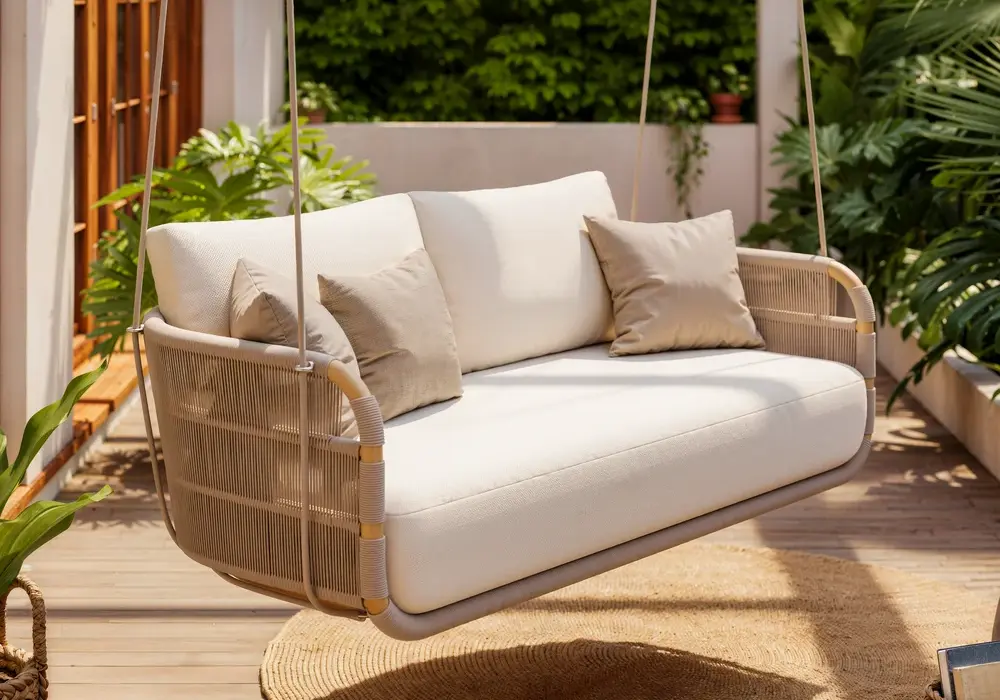
Because the structure hangs above head height, the only ground footprint is the base frame and the swing arc, which makes it the most space-efficient comfortable seating for a small patio.
Installation and safety notes
- Assembly is required, and the manufacturer suggests two people.
- If you mount to a balcony ceiling or beam, have a qualified contractor or building management confirm its load capacity first.
- Hang it exactly as the manufacturer instructs, and keep the swing path clear of walls, windows, and walkways.
A Single-Seater Hanging Chair for the Tightest Corner
The Costra Aluminum and Handwoven Rope Patio Hanging Swing Chair is the single-seat version of the same design, listed at 33 inches wide, 33 inches deep, and 20 inches high, with a 28-inch seat width, 21-inch seat depth, and an 11-inch seat height. It includes two removable cushions with machine-washable covers and has a stated capacity of 330 pounds.
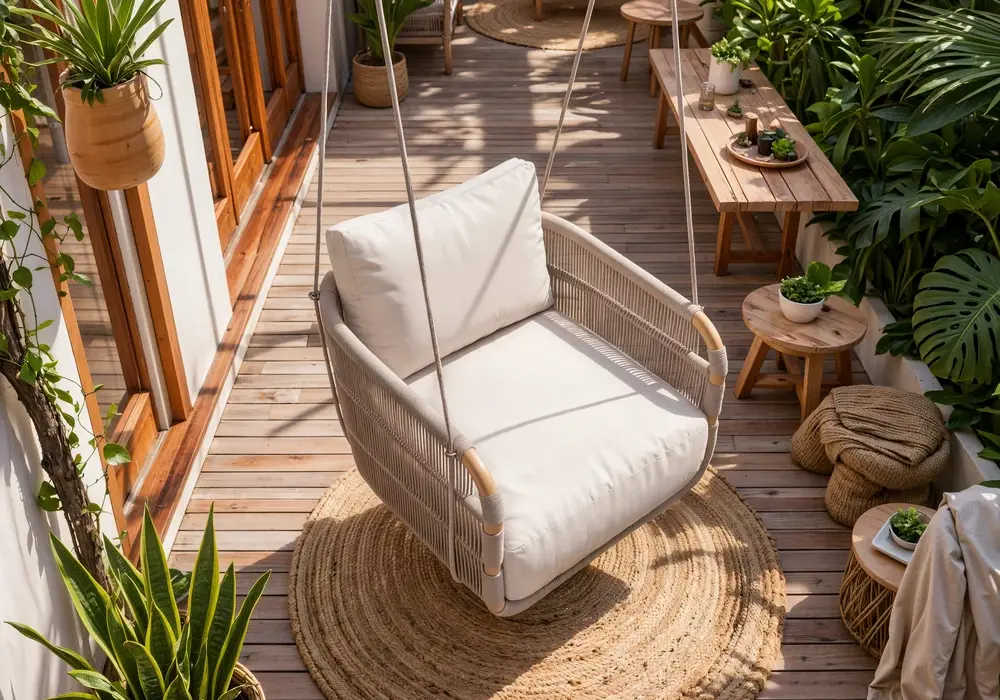
This is the option for the smallest patio, a balcony, or a corner of a larger deck where a loveseat will not go. Its 33-inch square footprint means you can place it against a wall or a railing and still have the rest of the space open.
Pair it with a small side table and the two together will occupy less floor area than a conventional bistro set while giving you a place to set a drink.
A Four-Piece Set That Seats Four in a Defined Area
The Martic 4-Piece Outdoor Rope Sofa Set is a complete grey set built on an aluminum frame with handwoven rope and high-performance canvas cushions. It seats up to four and includes a coffee table, seven cushions, and four accent pillows. The listed sofa piece measures 53.1 inches wide by 27.6 inches deep by 27.6 inches high, the chair measures 27.6 inches square, and the table measures 39.4 inches wide by 23.6 inches deep by 15.7 inches high.
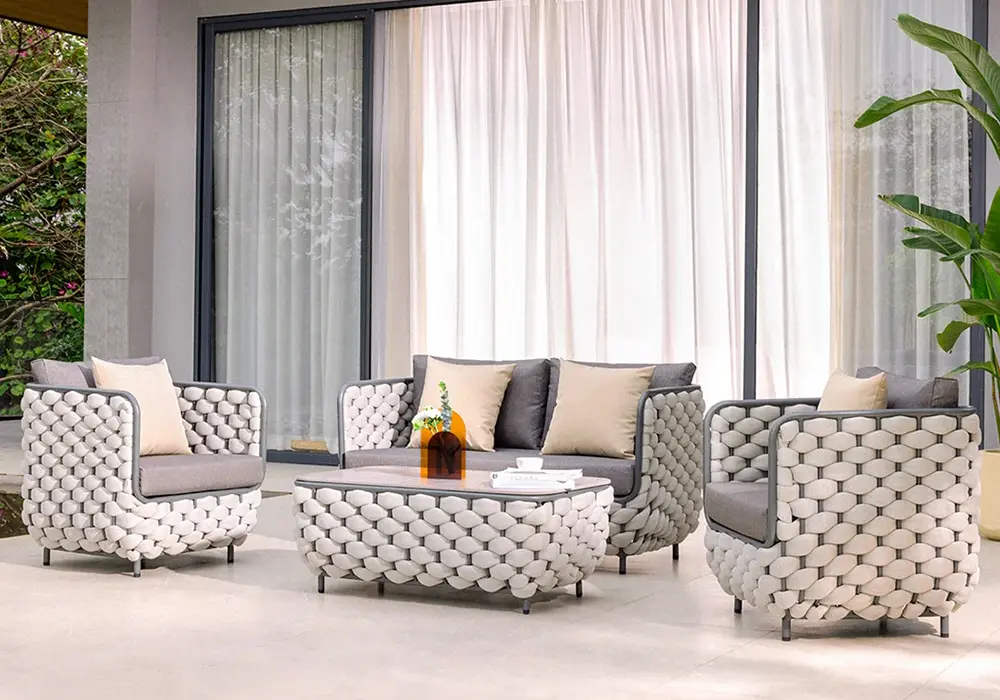
This set works for a small space only if you treat it as a defined conversation zone rather than scattering the pieces. Place the sofa against the longest wall, the chairs at an angle facing it, and the table centred.
Two details make this set work at this size. The sofa piece at 27.6 inches deep is shallow for outdoor seating, which means it projects less into the patio than a deeper sofa. And the table's low height of 15.7 inches pairs naturally with the seating height while staying low enough to step around rather than over.
The Mistakes That Ruin Small Outdoor Layouts
- Buying by seating capacity. A four-piece set and two chairs may seat the same number of people while occupying very different amounts of floor. Always compare the complete assembled footprint.
- Ignoring the table. The table is often a third of the floor area. Check whether it can be left out or swapped for something smaller.
- Underestimating the swing path. A hanging chair that swings into your walkway is a daily annoyance and a real safety issue.
- Forgetting cushions. Thick cushions make a seat comfortable but they also add bulk and need somewhere to dry. Count them before ordering and decide where they go in winter.
- Planning for the biggest party instead of the usual evening. A layout that works for six people once a year and is cramped every other day is the wrong trade. Choose for everyday use first.
Frequently Asked Questions
What is the most comfortable outdoor furniture for a small space?
A hanging swing or hanging chair is usually the most space-efficient comfortable option, since the seat is suspended and the floor footprint is limited to the base frame and swing path.
How much space do I need around outdoor furniture?
Plan on a clear main route of about 36 inches, with more where traffic is heavy. Between a seat and its coffee table, 16 to 24 inches is a comfortable reach for most adults.
How do I measure my patio before buying furniture?
Measure the narrowest length and width, subtract anything you cannot move, then tape the full arrangement on the ground and walk the route.
Are hanging chairs safe on a small balcony?
They can be, but the mounting structure's load capacity is the deciding factor. Confirm it with building management or a qualified contractor before installing anything.
Should I buy a four-piece patio set or individual pieces for a small space?
For a very small patio, individual pieces are usually more practical because a set has a fixed footprint. If four people genuinely sit most days, a compact set with a low table works well, provided you position it as one defined group.
How do I keep a small patio from feeling crowded?
Keep the palette restrained, use open-legged frames and pale cushions to look lighter, and choose a few practical cushions rather than a pile of decorative pillows.