

Do TV stand fireplaces use a lot of electricity? The short answer is: it depends almost entirely on the mode you use. Most TV stand electric fireplaces draw somewhere between 1,000W and 1,500W when the heater is running — enough to matter — but only 10-30W when you're just enjoying the flame effect without any heat. That's a massive gap: running one purely for ambiance costs pennies, while running the heater for hours a day pulls close to as much electricity as a small dedicated space heater.
This article breaks down exactly how many watts these units use, what that translates to in real running costs, how to cut that cost without giving up the heat, and what to know about circuit safety before you plug one in and forget about it.
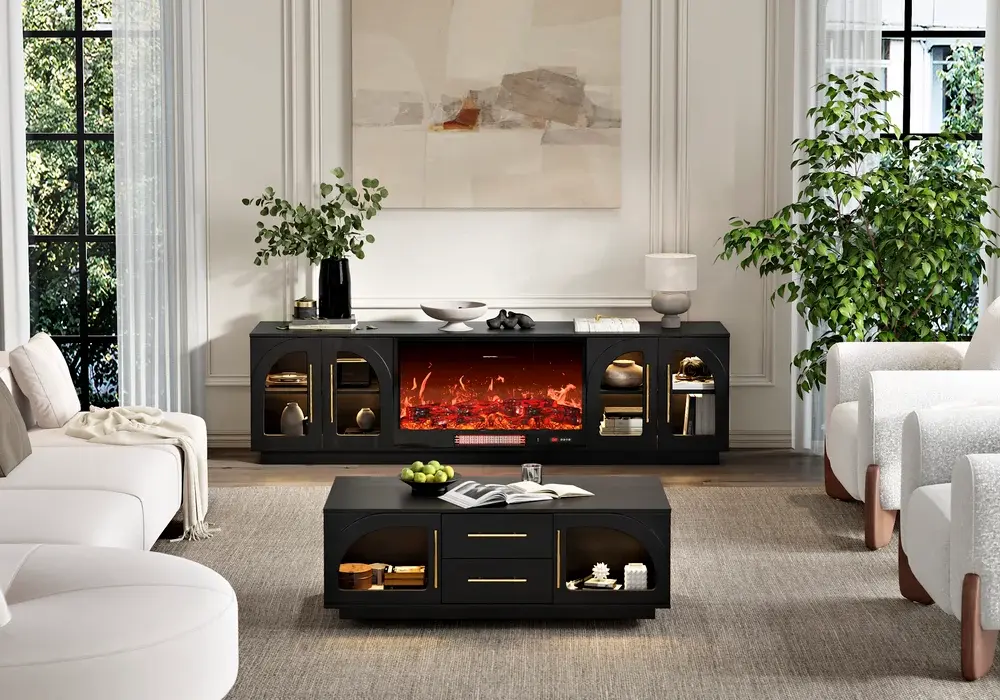
Arched Glass Doors TV Stand with Electric Fireplace
Table of Contents
How Many Watts Does a TV Stand Fireplace Actually Use?
To answer whether TV stand fireplaces use a lot of electricity, you first need the baseline number: most models are built around a heating element rated between 1,000W and 1,500W, with a separate low-power flame-only mode. The sections below break down the typical range, why rated wattage isn't the same as real-world draw, and where to check your own unit's number.
Typical wattage range: 1,000W to 1,500W on heater mode
Most TV stand electric fireplaces are built around a standard heating element rated between 1,000W and 1,500W on high, with a low-heat setting that typically draws around half that — roughly 500-750W. This range isn't a coincidence: 1,500W sits right at the edge of what a standard household electrical circuit can safely carry, so manufacturers design around that ceiling regardless of the unit's size or brand.
Rated wattage vs. actual electricity draw
That printed number — sometimes called the nameplate wattage or rated wattage — isn't the same as what the unit actually pulls from the wall over the course of an hour. Nearly all of these fireplaces have a thermostat. Once the room reaches your set temperature, the heating element cycles off, and electricity draw drops until the room cools slightly and the element switches back on. So a "1,500W" fireplace running for an hour in a well-insulated room won't necessarily use the full 1,500 watt-hours of electricity — it may cycle through several on/off bursts instead.
Where to check your unit's actual wattage
This matters because your real electricity use depends on more than the unit itself — room size, insulation, outside temperature, and your thermostat setting all affect how often the element cycles on. The most reliable way to know your own unit's draw is to check the rating label on the back of the unit, or the specifications section of the manual or product box. Units with remote-controlled temperature adjustment, like Homary's 71" Marble Veneer Electric Fireplace TV Stand, typically list this information in the manual that ships with the remote, making it easy to confirm your heat setting before you start tracking usage.
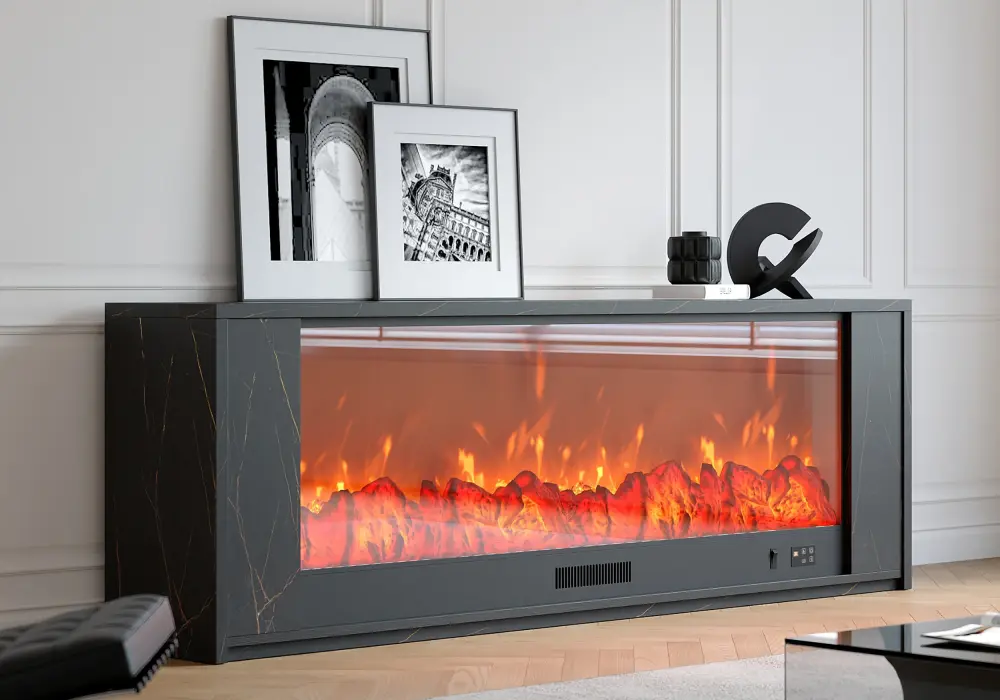
Flame Effect vs. Heater Mode — Where the Electricity Actually Goes
Not all parts of a TV stand fireplace use electricity equally, and this is where most of the confusion about "how much electricity does it use" comes from. The flame visual and the heater are two separate systems with very different power draws — understanding which one you're running is the single biggest factor in your electricity use.
The flame effect uses almost no electricity
One of the most common misunderstandings is assuming the flame visual is what drives electricity use. It isn't — not even close. The LED or holographic flame effect that makes these units look like a real fire typically draws under 30W, comparable to a couple of household light bulbs. You can run flame-only mode for an entire evening and the electricity cost barely registers. Some models lean into this: Homary's 87" Sintered Stone LED Flame TV Stand centers on a decorative flame display with adjustable brightness, so you get the ambiance for essentially the electricity cost of a lamp.
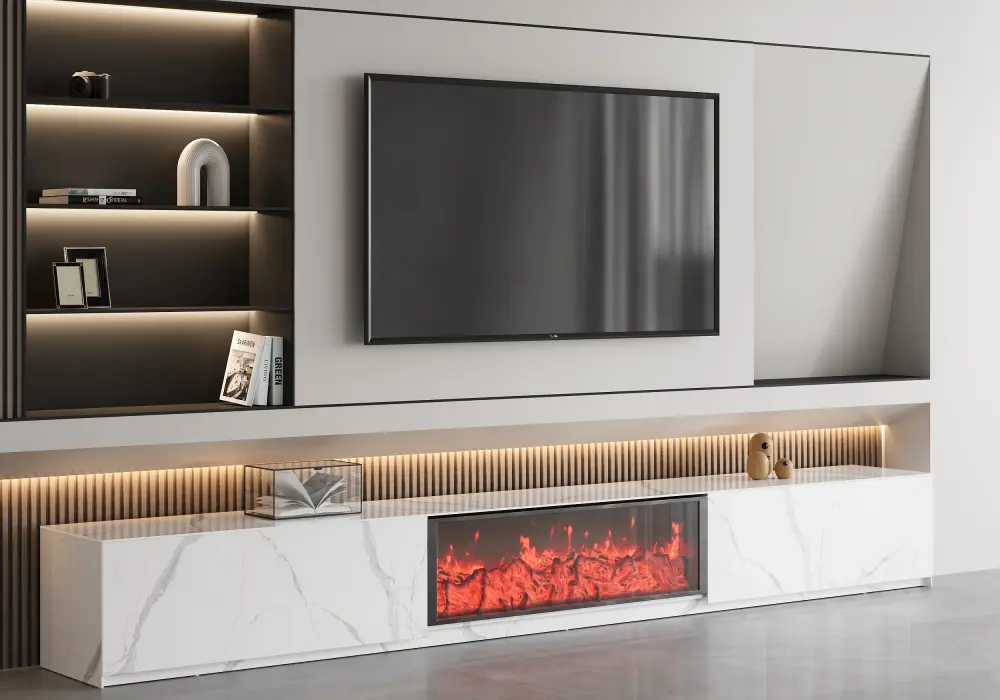
The heating element is the real power draw
The heating element is a completely separate system, and it's responsible for essentially all of the electricity these units consume. Most TV stand fireplaces let you run the flame effect with or without the heater, which is exactly why mode selection — more than brand, size, or price — determines how much electricity you actually use. If you want the cozy look without adding heat, flame-only mode is functionally a decorative light, not a heater, and your bill will reflect that.
Standby power: a minor factor, not the main cost
It's worth a quick mention that these units draw a very small amount of standby electricity even when switched off but still plugged in, from things like the remote sensor or display clock. This is typically a couple of watts at most and isn't a meaningful factor in your overall electricity use — the heater is where nearly all of the draw comes from.
What It Actually Costs to Run — By the Hour, Day, and Month
Watts only tell part of the story — what most people actually want to know is the dollar (or euro, or pound) figure. This section converts the wattage numbers above into a simple formula and a real cost table you can apply to your own electricity rate.
The formula: watts to real electricity cost
Here's the formula that turns wattage into an actual electricity cost, and you can reuse it for any appliance in your home:
kilowatts (kW) × hours used × your electricity rate = cost
To get kilowatts, divide watts by 1,000. So a 1,500W fireplace is 1.5kW. If your electricity rate is, for example, $0.15 per kilowatt-hour (kWh) — a reasonable placeholder, but rates vary widely by country and even by region within a country, so swap in your own local rate for an accurate figure — one hour on high heat costs roughly:
1.5 kW × 1 hour × $0.15 = $0.225 per hour
Hourly, daily, and monthly cost breakdown
Scaled out, here's what that electricity use looks like at different daily usage levels:
Daily use | Heater mode (1.5kW) | Flame-only mode (~20W) |
2 hrs/day | ~$0.45/day → ~$13.50/month | ~$0.006/day → ~$0.18/month |
4 hrs/day | ~$0.90/day → ~$27/month | ~$0.012/day → ~$0.36/month |
8 hrs/day | ~$1.80/day → ~$54/month | ~$0.024/day → ~$0.72/month |
Why the flame-vs-heater gap matters most
A few things jump out from this table. First, the gap between flame-only and heater mode isn't small — it's roughly a 75x difference in electricity draw, which is why mode choice matters more than almost any other factor in how much this appliance actually costs you. Second, even at 8 hours a day of heating, monthly electricity use sits in a range comparable to running a small space heater — noticeable, but not in the territory of a major appliance like an oven or central AC. Third, because electricity rates differ significantly by country — and even by time of day in places with peak/off-peak pricing — the exact numbers here are a starting point, not a universal figure. Check your utility bill or provider's rate to plug in your own number.
How to Cut the Cost — Thermostat, Timer, and Room Fit
If the electricity use above looks higher than you'd like, there's meaningful room to bring it down without giving up the fireplace entirely. The three levers below — thermostat, timer, and room fit — are the easiest ways to cut cost without changing how the unit looks or feels.
Use the thermostat instead of running it constantly
The single most effective lever is the thermostat. Rather than running the heater continuously at a fixed setting, let the thermostat cycle the element on and off based on your target temperature — this is usually already the default behavior, but double-check your unit isn't stuck on a "constant on" high setting, which will maximize electricity draw unnecessarily.
Set a timer to cap heating hours
Many models also include a timer, which lets you cap heating to a set number of hours rather than relying on remembering to switch it off manually. This is one of the simplest ways to prevent a unit from quietly running — and drawing electricity — long after you've left the room.
Match the unit's wattage to your room size
Heating efficiency also comes down to matching the fireplace to the room. Most 1,000-1,500W units are designed for small-to-medium rooms — a bedroom, home office, or standard-sized living room — not open-plan layouts or spaces with high ceilings, where heat disperses before it noticeably warms the air. Larger media consoles built for bigger rooms, such as Homary's 79" Warm White Electric Fireplace TV Stand with its adjustable temperature and customizable flame brightness, still draw from the same 1,000-1,500W range — the console size changes the room it suits, not the heater's electricity use. Closing doors to the room you're heating, and switching to flame-only mode once the room feels comfortable, are both simple ways to cut unnecessary draw.
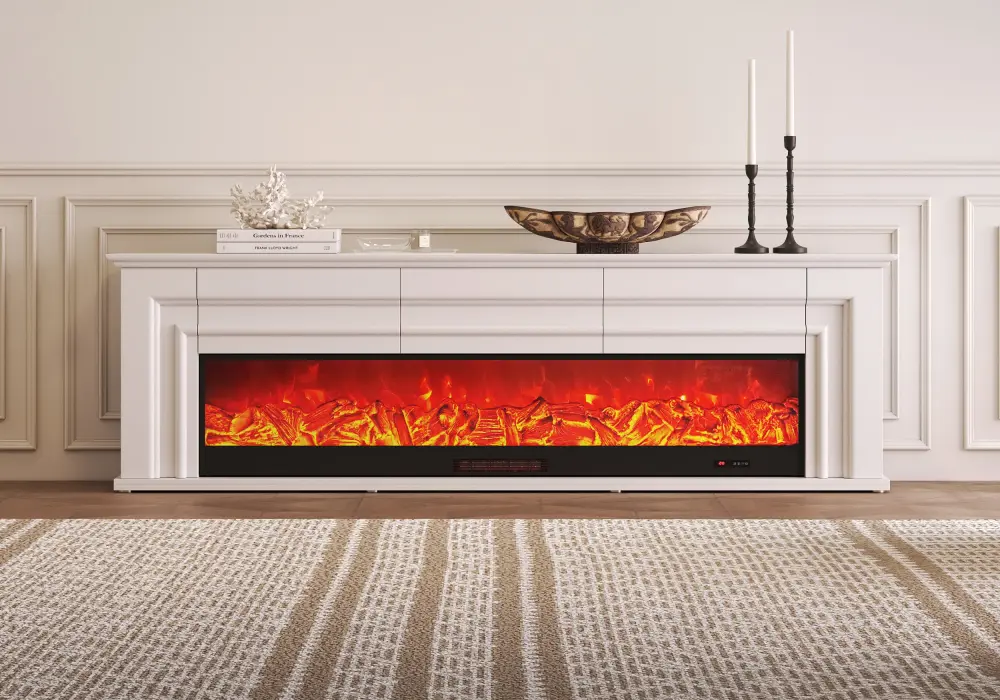
Circuit Load and Safe Continuous Use
Beyond cost, there's a safety dimension to how much electricity a TV stand fireplace draws. Because heater mode pulls close to the maximum a household circuit is designed for, it's worth understanding circuit load before running one for extended periods.
Why 1,500W is close to a circuit's limit
A 1,500W heater can represent a significant share of what a standard household circuit is rated to carry — this is a genuinely high-draw appliance, not a low-power gadget. Circuit standards vary by region — many homes in North America run on 120V circuits, while much of the rest of the world uses 220-240V circuits — but in either case, running a fireplace heater on the same circuit as other high-draw appliances (a hair dryer, microwave, or another space heater) increases the risk of tripping a breaker.
Simple precautions for continuous use
A couple of simple precautions go a long way: avoid plugging the unit into a low-quality extension cord or power strip, since these aren't always rated for sustained high-wattage electrical loads, and if you notice breakers tripping repeatedly, that's a sign to consult a licensed electrician rather than working around it. This is especially relevant if you're considering a hardwired installation rather than a standard plug-in unit — that's an electrician's job, not a DIY one.
Before You Buy or Keep Using One
Three numbers are worth knowing before you settle into a routine with a TV stand fireplace: the unit's actual wattage (check the label, not just the marketing copy), your local electricity rate, and how many hours a day you realistically expect to run it. With those three, the cost table above becomes a genuinely useful estimate rather than a guess.
If you're shopping for one, models with an adjustable thermostat, a built-in timer, and an independent flame-only mode give you the most control over electricity use and cost. And if your home frequently trips breakers, you're hoping to heat a large or open space for long stretches, or you're considering a hardwired setup, it's worth a conversation with a licensed electrician or HVAC professional before you commit — a TV stand fireplace is a solid option for warming one room affordably, but it isn't a replacement for a heating system built for your whole home.
FAQ
How many watts does a TV stand fireplace typically use? Most models draw 1,000-1,500W on heater mode and roughly 10-30W on flame-only mode.
Does flame-only mode use much electricity? No — the flame effect alone typically costs a fraction of a cent per hour to run.
How do I calculate the actual running cost? Multiply the unit's kilowatts by hours used and by your local electricity rate (kW × hours × rate = cost).
How can I reduce how much it costs to run? Use the built-in thermostat and timer instead of running continuously, heat only the room you're in, and switch to flame-only mode once the room is warm enough.
Can I leave it running for several hours safely?
Most units are designed for extended use with a thermostat cycling the heat, but avoid sharing a circuit with other high-draw appliances and don't use low-quality extension cords.
Can it trip a circuit breaker? It's possible if the fireplace shares a circuit with other high-wattage devices — if breakers trip repeatedly, have an electrician check your circuit load.