

A recliner sofa works by moving the backrest, the footrest, or both through a mechanism hidden beneath the seating. In a manual model, you trigger that mechanism with a handle, a lever, or body pressure. In a power model, an electric motor does the moving when you press a control. Headrests, armrests, and built-in accessories sit on top of this core system and change what the sofa can do.
Once you understand that, product descriptions become much easier to read. This guide explains the parts, the manual and power mechanisms, and what linked and independent movement mean.
Table of Contents
The Main Parts of a Recliner Sofa
Think of a recliner as a fixed frame with adjustable elements. Upholstery and cushions cover everything, while the mechanism underneath controls the motion.
Part | What it does |
Frame | Carries the seating and the weight of the people using it |
Backrest | Supports your back and may change angle |
Footrest (leg support) | Extends to support your legs |
Headrest | Supports your head; may adjust separately |
Mechanism | The linkage, and the motor in power models, that creates movement |
Controls | The handle, lever, or button panel that triggers movement |
Accessories | Extras such as a console or cooler with their own functions |
This is a list of functions, not a guaranteed parts list. Some sofas only adjust the backrest. Others have a fixed headrest or a different mechanism from the classic extending footrest. That is why "reclining" alone tells you very little about what a given sofa can do.
How a Manual Recliner Works
A manual recliner relies on a metal linkage, a set of connected steel arms and pivot points under the seat. At rest, the linkage is locked. When you pull a handle or lever, or lean back with enough pressure on designs built for it, the lock releases and the arms begin to move.
As the backrest tilts back, the arms push the footrest forward and upward. Pressing the backrest upright or pushing the footrest down reverses the sequence and returns everything to the closed position.
Manual designs have no motor or wiring, so there is less to go wrong. The trade-off is physical effort, and positions are often limited to a few stops. Not every manual design behaves the same way. Some use a handle, others use body pressure, and some adjust the back through supported positions without extending a footrest.
How a Power Recliner Works
A power recliner keeps the same basic idea but replaces your effort with a motor. When you press a control, the motor drives an actuator, a device that converts rotation into straight-line movement. LINAK, an actuator manufacturer, explains electric linear actuators in exactly these terms, and it also publishes actuator systems for recliner sofas. In a typical screw-driven design, a motor turns a screw, and a nut travelling along that screw produces the push or pull.
That push or pull moves the linkage, which tilts the back or extends the footrest. Because a motor does the work, the sofa can usually stop at positions you choose instead of at fixed stops. The controls are typically a built-in panel or a supplied interface.
One caution: LINAK's material describes a common approach, not the internals of any specific sofa. You can only identify a given sofa's system from its own specifications and manual.
Applying this to a power sectional with a cooler
Homary's Genuine Leather Built-In Cooler Power Reclining Sofa shows how the power mechanism plays out in a real sofa. It is a modular power sectional with dual power reclining mechanisms, so two motorized mechanisms handle the movement when you press a control. That is the motor-and-actuator system described above, which means the sofa needs an electrical connection to recline. Once the back is down, the adjustable headrests fine-tune head and neck support, which is what lets one sofa suit different lounging styles.
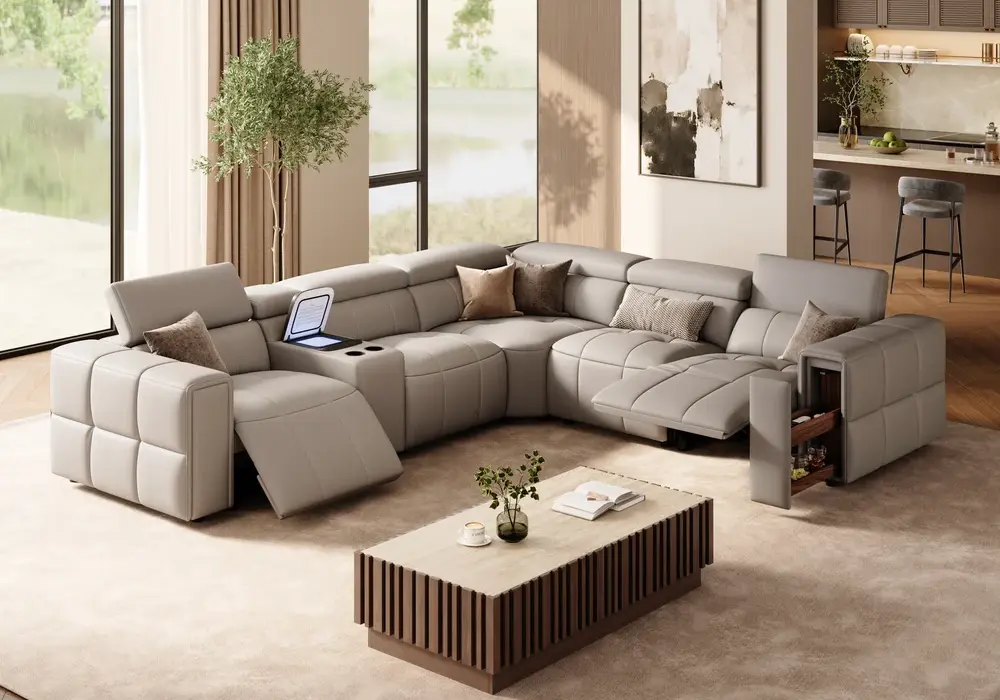
The extras are best read as additions on top of that core system. The 10.5L beverage cooler keeps drinks chilled and within reach, but it is an accessory and does not change how the sofa reclines. The modular construction lets you rearrange the sections to fit your room, and because reclining enlarges the footprint, it pays to plan the layout with the seats open rather than upright. Smaller details make the recliner easier to live with day to day: breathable, easy-care top-grain leather, high-resilience foam that keeps its shape, two-tier hidden armrest storage for remotes, and built-in USB and USB-C ports. The description does not say whether the headrests are motorized or which sections recline, so check the dimension diagram or ask the seller if either matters to you.
Manual vs. Power at a Glance
Manual | Power | |
Operation | Handle, lever, or body pressure | Button or supplied control |
Effort | Some physical effort | Minimal |
Positions | Often limited stops | Often adjustable within the range |
Electricity | Not needed for the recliner | Required |
Complexity | Simpler mechanism | More parts (motor, wiring) |
Linked vs. Independent Movement
In many recliners, the back and footrest move as one linked motion: tilt the back and the footrest rises with it. Others offer independent adjustment, where a specified part can be positioned separately from another. The sofa's specifications should say which one you are getting.
This distinction is easy to miss in marketing language, so here are three common traps:
- "Dual motor." It indicates a motor configuration, but it does not explain every adjustment. Check what each motor controls and whether the count refers to one seat or the entire sofa.
- Adjustable armrests. They tell you nothing about a powered backrest. They are a separate feature.
- Headrests. A headrest may be positioned manually even on a power-reclining sofa.
Applying this to a fabric sectional with an adjustable backrest
Homary's 2-Piece Yarn-Dyed Fabric and Faux Leather Reclining Sectional Sofa shows how an adjustable-back design can work differently from a classic recliner. Instead of extending a footrest, its adjustable backrest and seat frame rotate through 90°, which moves you between sitting upright and leaning back for lounging support. That counts as a reclining feature, but the description mentions neither a motor nor an extending footrest, so treat it as a different mechanism from the power recliners above.
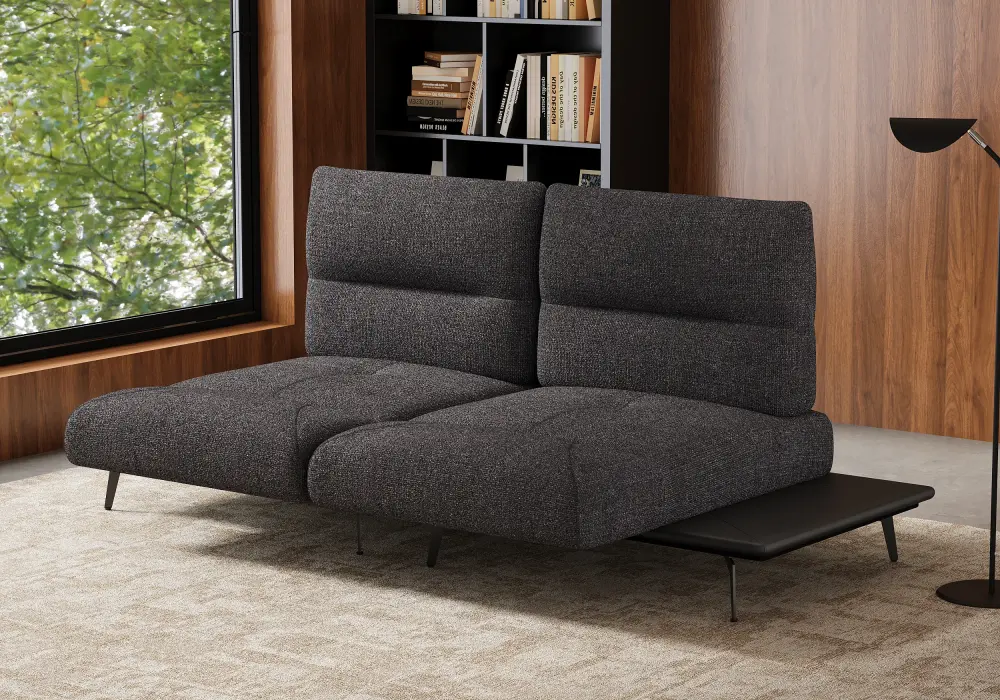
The armrests are a separate adjustment, and this sofa is a good reminder of the earlier point that adjustable armrests say nothing about how the back moves. Three adjustment levels let you set them for reading or an afternoon nap without touching the backrest. The yarn-dyed fabric and faux leather blend is built to keep its color and wear well, and the 6-inch metal legs lift the sofa off the floor for a light, airy look. If you want a footrest that extends, ask for explicit confirmation.
Applying this to an 85-inch sofa with an adjustable headrest
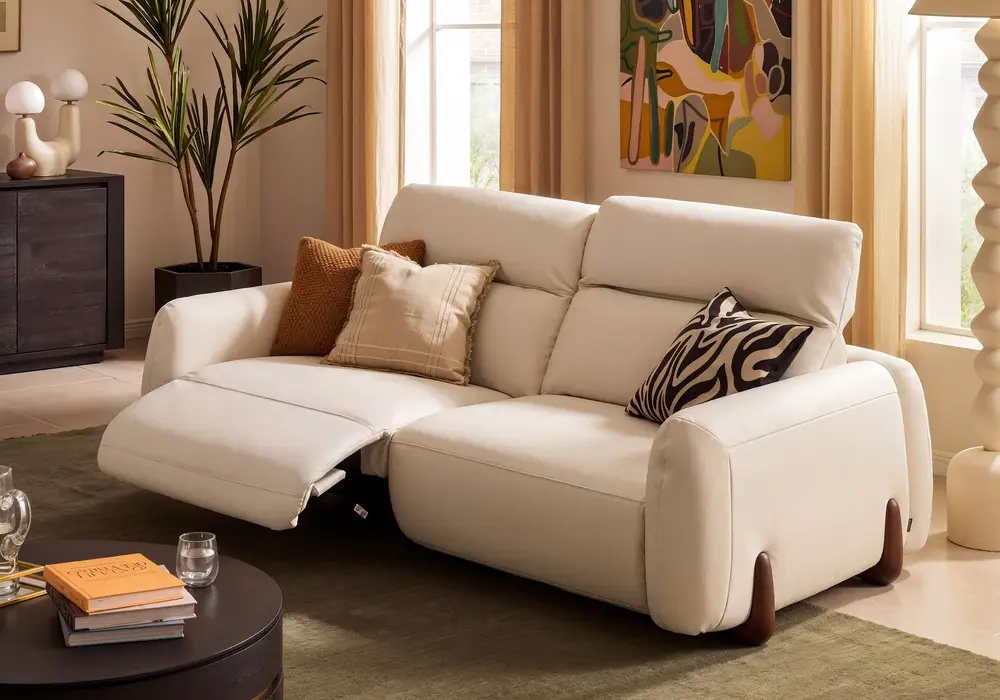
Homary's Curva 85" Genuine Leather Power Reclining Sofa with Adjustable Headrest is the clearest example of the headrest trap above. It has motorized seats on both ends, so each end seat reclines at the press of a button, yet its headrests are adjusted by hand and can be set at several angles. Power recline and headrest position are therefore two separate adjustments: the motors handle the reclining, and you set the head support yourself.
The controls are a two-button panel that also carries USB and USB-C ports, so charging sits right where you operate the sofa. Genuine leather covers the areas you touch, with durable faux leather on the back and sides, and high-resilience foam gives structured support. Walnut-finished oak legs add warmth and stable support. With two power seats at 85 inches wide, remember that this width is the upright size, so you still need the open footprint before judging fit.
How Much Space a Recliner Needs
Reclining changes the footprint. The footrest extends forward, and the back may swing toward the wall behind. Designs differ: some move mostly forward, while "wall-hugger" styles aim to move the back less. Even so, a marketing term like that still needs a specific placement requirement from the manual.
Measure the sofa both upright and fully open. Then think about the room, not just the sofa:
- Can you walk past without hitting the footrest?
- Is the coffee table clear of the extending footrest?
- Can you reach a drink while reclined?
- Can someone get to another seat while a person is reclined?
Before ordering, tape the open footprint on the floor and use the space normally for a day. A sectional with several motion seats needs more of this planning, because multiple seats may be open at once.
Before You Buy or Use One: A Quick Checklist
Product details vary, so confirm these points in the specific model's manual or listing:
- Which parts move (back, footrest, headrest), and whether they move independently
- Manual or power, and what the controls look like
- What "dual motor" or similar terms mean for that model
- Which seats recline on a sectional, and which are fixed
- Open footprint and required clearance
- Weight limits, and whether the footrest may be used as a seat
- Power requirements, and whether an approved backup exists during an outage
- Separate operating and care instructions for accessories such as a cooler
Always use the manual for your exact product and configuration. Another brand's instructions are not a substitute. La-Z-Boy's customer care page points to separate product manuals, and its La-Z-Motion operating instructions show how instructions differ by motion system and product version.
If it stops working properly: If the sofa binds, moves unevenly, makes unusual noises, or has a damaged cable, stop using it and contact the seller or an authorized service provider. Do not force the mechanism, apply lubricant, or open electrical enclosures yourself. Note the model, the affected control, and the behavior so support can identify the system.
Frequently Asked Questions
Does every recliner sofa need electricity?
No. Manual recliners work mechanically. Only powered designs need a supply, and accessories like a cooler may have their own requirements.
Can the backrest move without the footrest?
Only if the model offers independent adjustment. Many designs link the two, so ask for a demonstration of the position you want.
Does dual motor mean both seats recline independently?
Not necessarily. It describes the motor setup, not every adjustment. Confirm what each motor controls.
Can I close a power recliner during a power outage?
Only if the manufacturer provides an approved method. Do not force the footrest closed.
Does reclining turn the sofa into a bed?
No. Reclining is a lounging position, and only purpose-built sleepers have a sleeping mode.