

A windy afternoon can turn a comfortable patio into a cleanup job in minutes. Chairs can slide across a deck, lightweight tables can tip over, cushions can disappear into the yard, and an unsecured umbrella can become a surprisingly dangerous flying object. The problem gets even more serious when outdoor furniture lands in a driveway, damages a window, or ends up on a neighbor’s property.
So, how do you keep patio furniture from blowing away?
The answer is not simply to make everything heavier. A reliable setup combines the right anchoring method for your surface, low-profile ballast, secure straps, and a clear rule for when furniture should be brought indoors. The best approach also depends on whether you own or rent your home and whether the patio is sheltered or fully exposed to wind.
This guide explains practical ways to anchor and weigh down patio furniture on decks, concrete, pavers, and grass, plus a simple storm-prep system you can use before strong winds arrive.
Table of Contents
Safety and Compliance Checks Before You Start
Before drilling a hole or attaching a permanent anchor, check the rules that apply to your property.
For homeowners, local building requirements may affect permanent work on decks, balconies, patio structures, or other load-bearing elements. Building codes can also treat balconies, exterior decks, and canopies as structural components that need to resist lateral and wind loads.
For renters, read your lease or rental agreement before drilling into a deck, concrete slab, railing, or wall. Apartment and condominium residents should also check building-management, HOA, or common-area rules. A balcony may look like private outdoor space, but the structure itself can be subject to building requirements and property-management restrictions.
In practice, patio-furniture anchoring falls into three categories:
Installation type | Best for | Typical approach |
Permanent | Homeowners with permission | Structural screws, expansion anchors, or approved anchor plates |
Semi-permanent | Seasonal use | Removable anchor eyes, ground anchors, or attachment brackets |
Temporary / non-damaging | Renters and delicate surfaces | Weighted bases, ballast bags, furniture-linking straps, and low-profile restraints |
Before installation, identify the actual structural material beneath the surface. A deck board is not automatically a structural anchoring point, and a patio paver is not the same thing as a concrete foundation.
After installation, take a few photos of the completed setup. They are useful later when you need to remember strap positions, anchor locations, or the correct arrangement before a storm.
How to Anchor Patio Furniture by Surface Type
The most effective way to keep patio furniture from blowing away is to match the anchoring system to the surface beneath it. A method that works well on concrete may be ineffective or damaging on pavers or decking.
Wooden Decks
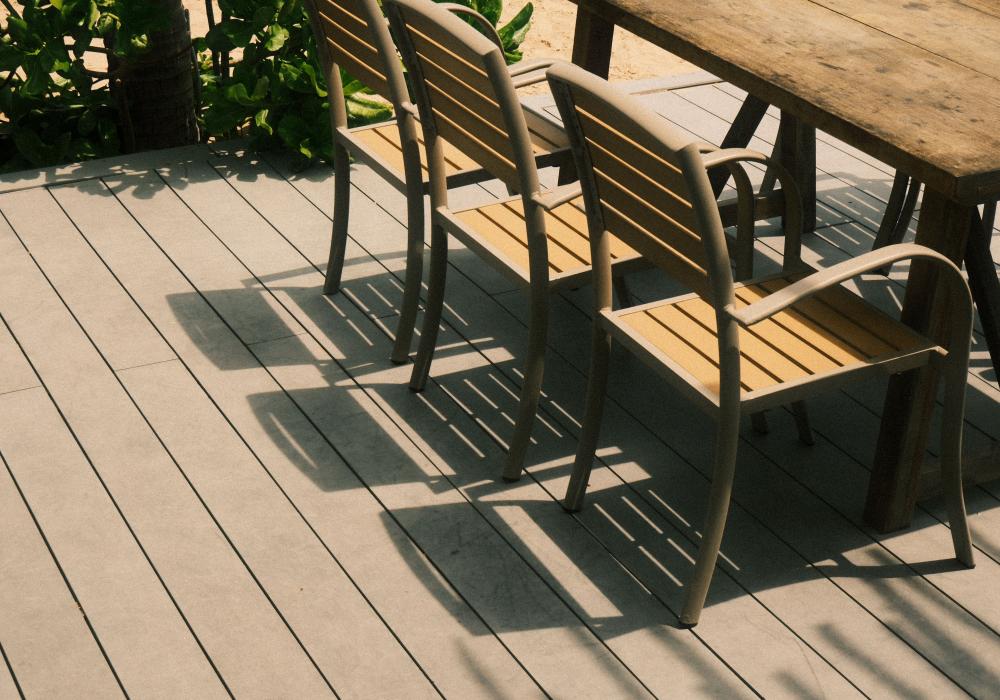
For a wood deck, attach the restraint to structural framing whenever possible rather than relying on a thin deck board alone. A common homeowner approach is a stainless or corrosion-resistant structural screw or lag-style fastener connected to a heavy-duty eye plate, bracket, or furniture restraint.
For light-to-medium furniture, a practical starting point is a 5/16- or 3/8-inch structural screw or lag screw, roughly 3 to 4 inches long, provided the fastener length is appropriate for the actual framing thickness and the manufacturer’s installation requirements. Do not simply choose the longest screw available; it must not interfere with wiring, plumbing, or other concealed elements.
Tools: drill/driver, appropriate drill bit, socket or wrench, measuring tape, and eye protection.
Estimated time: 15–30 minutes per anchor location.
Typical cost: roughly $15–$40 for a basic restraint setup, depending on hardware and corrosion resistance.
Pre-drill when required by the fastener manufacturer and avoid installing too close to the edge of a joist or board. Structural-fastener guidance emphasizes correct spacing and installation because withdrawal resistance depends heavily on how the fastener engages the structural member.
For renters, skip the drilling and use weighted furniture links or straps that connect several pieces together. Linking chairs and tables can make them behave more like one heavier unit, but it should not be considered equivalent to structural anchoring in severe wind.
Source pexels
Concrete Patios and Slabs
Concrete gives you more permanent anchoring options. Mechanical expansion anchors or concrete screw anchors can be used to connect a bracket, ring, or restraint point to the slab.
A commonly useful range for small outdoor restraint hardware is 3/8- to 1/2-inch-diameter anchors, with length selected according to the anchor type, fixture thickness, required embedment, and slab thickness. For example, manufacturer documentation for concrete anchors shows that required drill depth, embedment, and tightening torque vary significantly by diameter and anchor design.
This is important: there is no universal torque value for all concrete anchors. Some screw anchors do not require additional torque, while expansion anchors do. Simpson Strong-Tie specifically notes that its Titen HD screw anchors are installed differently from torque-dependent expansion anchors.
For example, one Hilti HST3 specification lists tightening torque values ranging from 20 Nm for M8 anchors to 45 Nm for M10 and 60 Nm for M12, depending on the exact anchor configuration.
Tools: rotary or hammer drill, masonry bit, vacuum or brush for hole cleaning, wrench or torque wrench, and eye protection.
Estimated time: 20–40 minutes for two to four anchor points.
Typical cost: about $20–$60 for a small hardware setup, excluding power-tool costs.
For a rental, a freestanding weighted base, heavy planter, or removable ballast system is usually the lower-risk alternative.
Pavers
Pavers require extra caution because the visible paving unit may not provide reliable pull-out resistance. Do not assume that drilling into a single paver creates a strong anchor.
For permanent installations, locate the structural layer below the pavers and determine whether there is a concrete slab or another suitable anchoring substrate. If you cannot verify the base, use ballast instead.
A practical rental-friendly setup is to place a weighted base, sandbag, or dense planter directly over or beside the furniture’s restraint point, then connect the furniture with a weather-resistant strap. Keep the restraint low so it does not create a tripping hazard.
Grass and Soil
On grass, permanent-style anchoring is usually unnecessary for ordinary patio chairs and tables. For exposed locations, use heavy-duty ground screws, auger-style stakes, or other rated ground anchors with straps.
Install them according to the manufacturer’s instructions, and avoid relying on a short straight stake in loose or wet soil. Soil type, moisture, root systems, and installation depth can dramatically affect holding strength.
Tools: mallet or installation bar if required, straps, gloves, and sometimes a hand auger.
Estimated time: 10–20 minutes.
Typical cost: around $15–$50 for basic ground anchors and straps.
For seasonal wind, use a low-center-of-gravity strategy: anchor the furniture frame low, place ballast close to the feet, and avoid creating a tall stack that can tip.
Weighing Down Patio Furniture: Store-Bought and DIY Options
When drilling is not appropriate, ballast is often the simplest way to reduce movement. The goal is to add weight where it is most effective—not simply place something heavy on the seat.
Commercial options include weighted umbrella bases, water-fillable bases, sand-filled ballast bags, heavy planters, and furniture-weight systems.
Option | Advantages | Limitations | Best use |
Weighted base | Stable and tidy | Can be expensive or bulky | Umbrellas and single pieces |
Water-fillable base | Easy to move when empty | Less practical in freezing conditions | Seasonal setups |
Sandbags | Flexible and inexpensive | Less attractive; can shift | Storm preparation |
Heavy planters | Functional and decorative | Must be secured from tipping | Tables, benches, partitions |
DIY ballast | Low cost and customizable | Needs careful placement | Budget setups |
There is no universal ballast weight that guarantees a piece of furniture will stay put in every wind condition. Wind force depends on the exposed surface area, shape, height, openings, friction with the ground, furniture weight, and the direction and duration of gusts.
For a rough planning estimate, think in terms of wind force versus resisting force rather than a single magic weight number. A simplified relationship is:
Wind force ≈ wind pressure × exposed area × drag factor
Because wind pressure rises rapidly as velocity increases, doubling wind speed produces roughly four times the pressure. That is why a setup that is stable during a breezy afternoon may become unreliable during much stronger gusts.
For everyday use, begin by placing ballast low and close to the furniture’s feet or base. On an exposed patio, use more restraint than you would in a sheltered courtyard. Place weight toward the windward side when the expected wind direction is known, but avoid creating a single overloaded point that can twist the frame.
A good DIY approach is to use sealed sandbags or purpose-made weight bags attached to the frame with webbing straps. Avoid loose blocks that can slide, sharp-edged objects that can cut fabric, or improvised weights resting on glass tabletops.
The best system often combines methods: anchor one or two key pieces, connect lightweight chairs together, and add ballast to anything that cannot be permanently attached.
How to Secure Umbrellas, Canopies, and Cushions
The lightest patio items are often the first to become airborne.
Patio Umbrellas
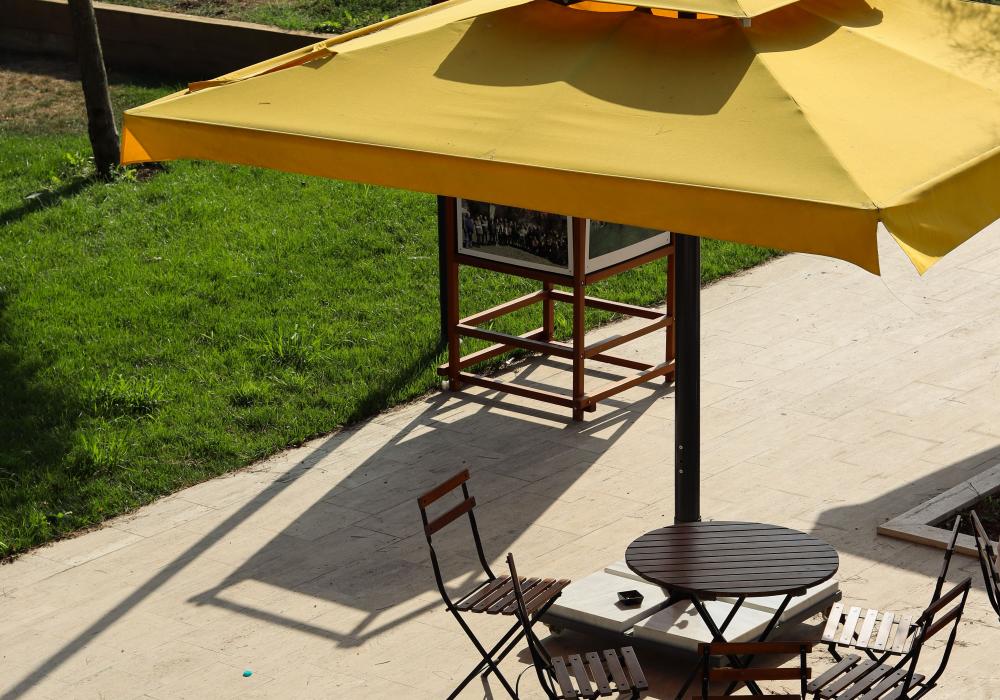
An umbrella needs more than a decorative base. Choose a base designed for the umbrella’s diameter and overall height, and follow the base manufacturer’s recommended weight.
As a rule of thumb, the taller and larger the umbrella, the more important the base, low center of gravity, and secondary restraint become. On exposed patios, consider using a base that can be mechanically restrained or supplemented with additional ballast.
Never rely on an umbrella being “heavy enough” during severe wind. The National Weather Service notes that umbrella use becomes difficult once winds reach roughly 25–31 mph, while loose lawn furniture can be tossed or toppled in the 30–44 mph range.
In other words, an umbrella should come down before wind reaches the point where patio furniture begins moving.
Source pexels
Canopies and Gazebos
Canopies have a large surface area that can catch wind like a sail. Use all manufacturer-provided tie-down points, connect straps to appropriate ground anchors or structural points, and keep each strap aligned with the intended load path.
For temporary fabric structures, a 1- to 2-inch-wide weather-resistant webbing strap is generally easier to control than a thin cord. Use a ratchet strap only where the furniture or anchor point can safely tolerate concentrated tension. Over-tightening can crush tubing, deform frames, or damage fabric.
Bungee cords are useful for keeping covers and lightweight items in place, but they should not be treated as primary structural restraints for a large canopy in high winds. Their elasticity can also allow an object to keep moving even while restrained.
Cushions and Small Accessories
Bring loose cushions, seat pads, rugs, decorative pillows, lightweight side tables, and umbrellas indoors whenever strong winds are forecast. The NWS and federal emergency-preparedness guidance both recommend securing or bringing in unsecured outdoor objects because high winds can turn them into hazardous debris.
A deck box with a secure lid is useful for normal breezy weather, but during a serious storm, indoor storage is safer when practical.
Wind Speed Thresholds and a Storm-Prep Checklist
There is no single wind speed at which every patio chair becomes unsafe. Furniture design, weight, surface, exposure, and gust direction all matter.
Still, practical thresholds can help you make decisions quickly.
Wind condition | Practical action |
Under 20 mph | Normal setup; check that lightweight items are stable |
20–30 mph gusts | Add ballast, close umbrellas, secure cushions |
30–40 mph gusts | Secure or store lightweight furniture; bring in loose accessories |
40+ mph sustained or strong warning conditions | Move unsecured furniture indoors or to a protected location |
Severe/high-wind warning | Prioritize indoor storage; do not attempt outdoor adjustments during dangerous conditions |
These are conservative household guidelines, not universal engineering limits. The National Weather Service reports that lightweight loose objects such as lawn furniture can be tossed or toppled at about 30–44 mph, and its high-wind guidance emphasizes securing outdoor objects before dangerous conditions develop.
The key point is timing: do not wait until the furniture is already moving.
How to Move Heavy Patio Furniture Safely
Heavy furniture can be just as dangerous to move as it is to leave outside.
Work with another adult when necessary. Clear the route first, remove cushions and loose accessories, and use a furniture dolly or hand truck for bulky pieces. Protect indoor flooring with moving blankets, cardboard, or protective mats.
Do not drag metal legs directly across wood flooring, finished concrete, or delicate tile. For especially heavy tables or built-in pieces, use a professional mover rather than attempting a last-minute lift during worsening weather.
24-Hour Storm-Prep Checklist
24 hours before
- Check the latest local forecast and expected peak gusts.
- Inspect anchor points, straps, brackets, and umbrella bases.
- Move cushions and decorative accessories into storage.
- Check that drains and patio access paths are clear.
- Decide where large furniture will go if it needs to be moved indoors.
6 hours before
- Close and remove patio umbrellas.
- Secure or remove canopies and lightweight shade structures.
- Add ballast to furniture that will remain outside temporarily.
- Link lightweight chairs or tables where appropriate.
- Move planters and other loose objects away from exposed edges.
1 hour before
- Bring in anything that can still be safely moved.
- Check that no loose straps, covers, ropes, or cushions remain.
- Confirm doors to storage areas are closed and secured.
- Stop working outside once conditions become unsafe.
- Take shelter and follow local emergency instructions when severe wind is expected.
One important rule applies throughout the process: never go outside during dangerous wind simply to rescue furniture. High winds can carry debris and can shift objects unexpectedly. The NWS warns that flying objects are a significant safety hazard during high-wind events.
Conclusion: Build a Patio That Is Ready for the Wind
Knowing how to keep patio furniture from blowing away is really about creating layers of protection. Start with the correct anchoring method for your surface, then add ballast where permanent drilling is not practical. Keep umbrellas, cushions, and canopies under stricter rules because they can become unstable much earlier than heavier furniture.
Most importantly, know when to stop trying to secure things outdoors and bring them inside. Strong winds can exceed what a homeowner-installed restraint system was designed to handle.
Save or print the storm-prep checklist above, and keep an anchor-by-surface guide with your patio supplies. A few minutes of preparation can prevent damaged furniture, broken property, and dangerous flying debris.
FAQ
At what wind speed should I secure or store patio furniture?
Start securing lightweight items when gusts approach 20–30 mph, and plan to bring unsecured or lightweight furniture indoors as gusts approach 30–40 mph. The NWS notes that lightweight lawn furniture can be tossed or toppled in the 30–44 mph range.
What anchors work best on wooden decks vs. concrete or pavers?
On structural wood framing, use appropriately sized corrosion-resistant structural screws or lag-style fasteners. On concrete, use a concrete-rated screw or expansion anchor selected for the slab and fixture. Pavers should not automatically be treated as structural anchoring material; use the underlying structural layer when appropriate or choose ballast instead.
How much weight does an umbrella base need to resist typical gusts?
There is no universal weight because umbrella size, height, canopy shape, exposure, and base design all change the wind load. Follow the umbrella-base manufacturer’s specifications and take the umbrella down before strong winds. Umbrella use becomes difficult at roughly 25–31 mph according to NWS guidance.
Can I anchor patio furniture on a rental property without causing damage?
Usually, the safest approach is a non-damaging solution such as weighted bases, ballast bags, furniture-linking straps, or removable ground restraints where permitted. Always check your lease and property-management rules before drilling or attaching anything permanently.
What’s the safest way to use ratchet straps or bungee cords without damaging furniture?
Use a broad, weather-resistant strap with padding between the strap and finished surfaces. Tighten only enough to prevent movement; excessive tension can deform tubular frames or damage fabric. Bungee cords are better for light-duty retention than for replacing structural anchors on large or wind-exposed structures.
Do I need special anchors for balconies or rooftop patios?
Potentially, yes. Balconies and rooftop patios may have specific structural, waterproofing, access, and property-management requirements. Do not drill into a balcony slab, waterproofing system, railing, or parapet without confirming that the proposed attachment is permitted and structurally appropriate. Building codes commonly require exterior balconies and similar structures to resist relevant lateral and wind loads.