

A well-styled coffee table does more than fill the space in front of a sofa. It can establish the visual center of a living room, make seating feel proportionate, provide a convenient surface for drinks and books, and add practical storage without making the room feel crowded.
The key is to style the coffee table after choosing the right scale. A beautiful centerpiece cannot compensate for a table that is too large for the seating area, too low for the sofa, or positioned so far away that reaching a drink becomes inconvenient.
For most U.S. living rooms, the best approach is to work from the room outward: measure the sofa and available floor space, determine the appropriate coffee table dimensions, establish comfortable clearances, and then build the tabletop arrangement around everyday use.
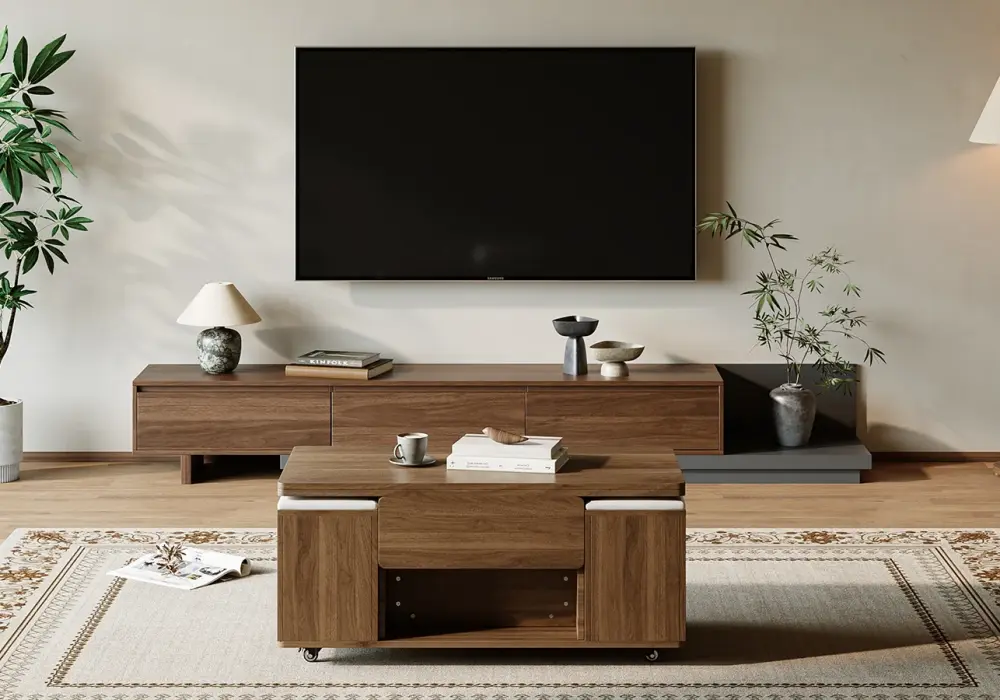
Source Homary
Choosing the Right Scale and Shape
Before choosing decorative objects, determine whether the coffee table itself is the right size for your seating arrangement. A useful starting point is to select a table approximately two-thirds the length of the main sofa. This creates enough visual weight without allowing the table to dominate the seating area.
Height matters just as much. For a typical American sofa with a seat height of around 17–19 inches, a coffee table around 16–18 inches high usually creates a comfortable relationship. As a general rule, the tabletop should be roughly level with the sofa cushion or 1–2 inches lower.
Living Room Setup | Typical Coffee Table Height | Approx. Table Length | Recommended Sofa-to-Table Gap |
Standard sofa | 16–18 in. | 40–60 in. | 14–18 in. |
Sectional | 16–18 in. | 48–60+ in. | 14–18 in. |
Low-profile sofa | 14–16 in. | 40–54 in. | 14–18 in. |
Reclining sofa | 17–19 in. | 48–60+ in. | Check footrest path first |
Compact apartment sofa | 15–17 in. | 36–48 in. | 12–16 in. |
The shape should respond to the room rather than simply matching the sofa.
Rectangular tables work well with standard sofas and long sectionals because their proportions follow the seating line. Round and oval tables are useful when circulation is tight because there are no sharp corners to catch on when people walk around them. A square table can work particularly well with symmetrical seating arrangements or a compact sectional, but it can consume floor space quickly in a small room.
Think about the surrounding furniture, too. If the table sits on a large area rug, all or most of the coffee table should generally sit comfortably within the rug rather than appearing to float at its edge. In homes with young children or pets, rounded corners and durable surfaces can be more practical than thin glass or sharp-edged designs.
The goal is not to maximize table size. It is to maximize the amount of usable surface without sacrificing circulation.
Arrangement and Balance: Placement Templates and Spacing Rules
Once the table is correctly sized, placement determines whether the living room feels open or cramped.
For most seating arrangements, start with approximately 14–18 inches between the sofa and coffee table. This is close enough for comfortable reach while leaving sufficient space for legs and movement. In a particularly compact room, around 12 inches may work, but reducing the gap too much can make the seating area feel congested.
The table should also leave a practical path around the seating group. Main circulation routes should generally remain around 30–36 inches wide when the room allows it. If the coffee table sits directly between a sofa and another frequently used pathway, prioritize movement over decorative symmetry.
Traditional Sofa + Coffee Table
For a standard sofa facing the television or another seating area, use a rectangular table about two-thirds the sofa's length.
Layout template:
Sofa → 14–18 in. gap → Coffee table → 30–36 in. circulation zone
Keep the center of the table visually connected to the sofa rather than positioning it according to the television alone.
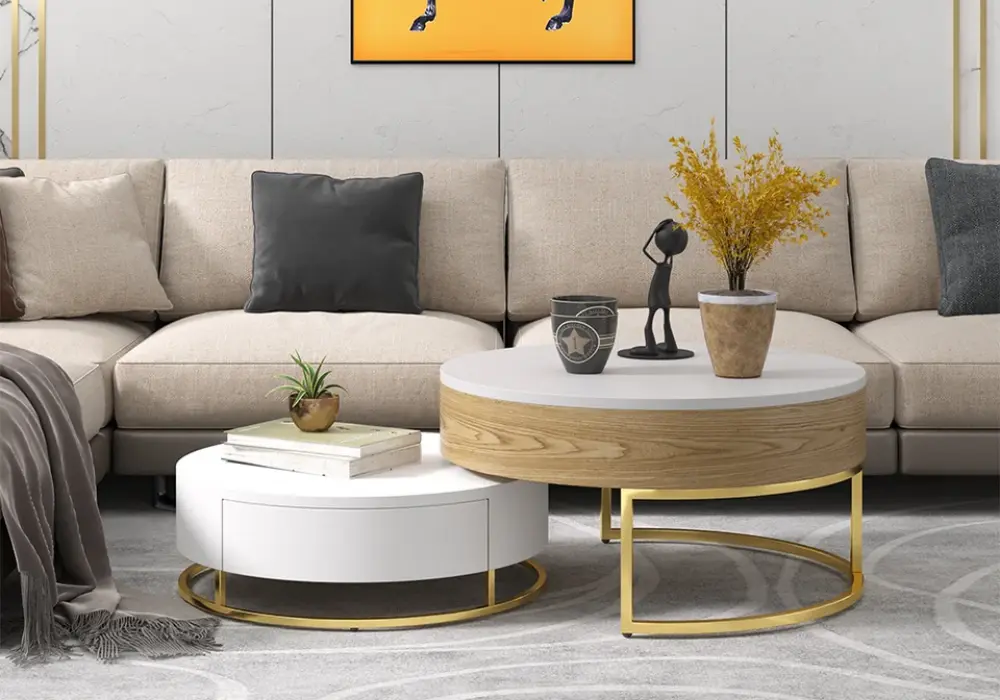
Source Homary
Sectional Sofa
A sectional gives you more flexibility, but its larger footprint also makes proportion more important.
A rectangular or oval coffee table generally works well with an L-shaped sectional. Position the table inside the open area of the sectional while maintaining enough clearance for people to enter and leave the seats.
For a deep sectional, a table that is too small can look visually lost. In this situation, increasing the table length is often more effective than simply choosing a wider table.
Sofa + Accent Chairs
With one sofa and one or two accent chairs, a round or oval table can connect the separate seating pieces visually.
Keep the table centered within the conversation area rather than aligned exclusively with the sofa. This makes the furniture arrangement feel like one cohesive zone.
Small Apartment Layout
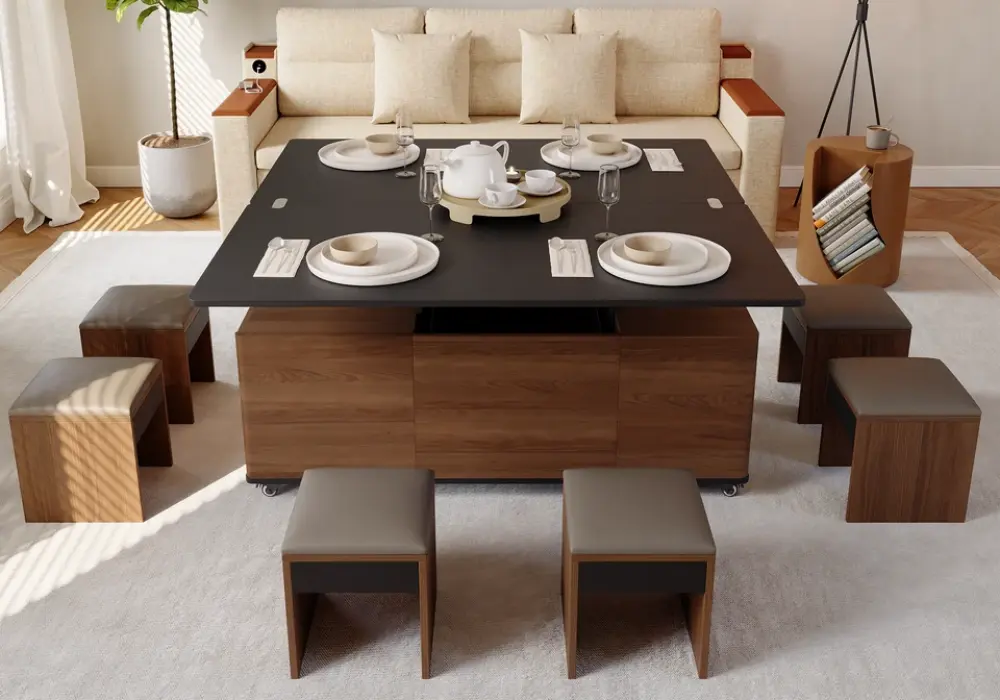
In a small apartment, consider a compact round table, nesting tables, or a lift-top design.
Instead of filling the entire center of the room, choose a table that leaves a clear circulation path between the seating area, kitchen, entryway, and other frequently used spaces.
A Simple Styling Formula
After the placement is correct, divide the tabletop into three functional zones:
- Center zone: one visual focal point
- Reach zone: drinks, remotes, books or a small tray
- Open zone: intentionally empty surface for everyday use
A common styling mistake is covering the entire tabletop with decorative objects. A coffee table is still furniture designed to be used. Leaving approximately 30–50% of the surface visually open can make the arrangement feel more intentional and practical.
Coffee Table Styling Checklist
Before adding more decor, check:
- Measure the sofa and table.
- Confirm the table height.
- Check the 12–18 inch seating clearance.
- Confirm walking paths remain open.
- Choose one dominant centerpiece.
- Add one or two functional groupings.
- Vary object heights.
- Remove anything that interferes with drinks, books or remotes.
- Check the arrangement from the sofa and from the room entrance.
- Leave enough negative space.
This process is more reliable than buying decorative objects first and trying to make them fit afterward.
Heights, Layers, and Focal Centerpiece Ideas
Good coffee table styling is largely a matter of height and layering.
If every object is the same height, the arrangement can look flat. If everything is tall, it can obstruct sightlines and make the table feel cluttered. A better composition combines low, medium and high elements.
A practical range is:
- Low layer: 1–3 inches, such as a tray or shallow bowl
- Medium layer: 3–8 inches, such as stacked books or a ceramic vessel
- High layer: 8–14 inches, such as a small vase, plant or sculptural object
The highest object should generally remain low enough that people sitting on the sofa can still see across the room.
Here are ten centerpiece combinations that can be adapted to different interiors:
Centerpiece | Typical Height | Best For |
Tray + candleholders | 5–10 in. | Modern, transitional |
Books + small sculpture | 6–12 in. | Mid-century |
Ceramic vase + greenery | 8–14 in. | Farmhouse, organic |
Low bowl + decorative objects | 3–6 in. | Minimalist |
Tray + coffee-table books | 4–8 in. | Contemporary |
Small plant + stone vessel | 6–12 in. | Natural interiors |
Decorative box + book stack | 5–9 in. | Traditional |
Sculptural object + tray | 6–12 in. | Modern |
Seasonal flowers + bowl | 8–14 in. | Transitional |
Lantern + low greenery | 8–14 in. | Rustic, farmhouse |
The important principle is one dominant focal point rather than several competing focal points.
For example, if you already have a large sculptural vase, you probably do not need another tall object beside it. Add lower books or a tray instead. Conversely, if your tabletop contains only low objects, introduce one taller element to create vertical variation.
Scale should also relate to the table itself. On a large 54-inch coffee table, a tiny 4-inch decorative object can disappear visually. On a 36-inch table, the same object may be sufficient.
A useful test is to look at the arrangement from the sofa. If the centerpiece blocks the television or obstructs conversation, reduce its height. If the table looks visually empty from several feet away, increase the scale rather than simply adding more small accessories.
Functional Organization, Safety, and Kid- and Pet-Friendly Styling
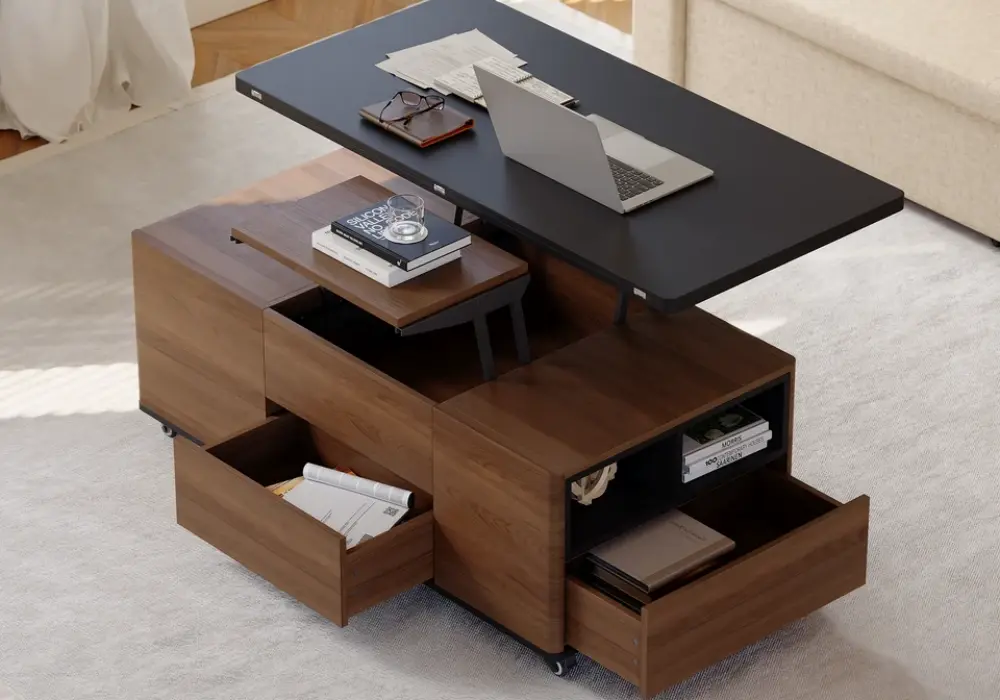
Source Homary
A stylish coffee table should support the way the living room is actually used.
Instead of treating storage as an afterthought, use the tabletop and lower storage areas to separate everyday items from decorative pieces.
A shallow tray can create a dedicated zone for remotes. A lidded box can hide charging cables or small accessories. A lower shelf can hold books, blankets or baskets while keeping the tabletop relatively clear.
For homes with children or pets, material selection becomes part of styling.
Material / Feature | Durability | Family-Friendly Use | Main Consideration |
Solid wood | High | Excellent | Can show scratches over time |
Metal | High | Excellent | Edges and corners should be checked |
Stone | High | Good | Heavy and can have hard edges |
Tempered glass | Medium–High | Moderate | Fingerprints and visible edges |
Thin glass | Lower | Poorer choice | More vulnerable to impact |
Scratch-resistant laminate | Medium–High | Excellent | Quality varies by construction |
Veneer | Medium | Good | Avoid excessive moisture |
For families with toddlers, rounded corners are generally preferable to sharp rectangular edges. Heavy, stable tables are also less likely to shift when bumped.
Decor should follow the same principle.
Avoid placing fragile ceramics, unstable sculptures or hot candles where children or pets can easily reach them. Instead, use heavier vessels, low-profile bowls, wood accessories, books and secured trays.
For pets, also consider whether the table creates a tempting climbing surface. A lightweight decorative object placed near the edge can quickly become a hazard.
A Family-Friendly Styling Checklist
Before considering the table finished, ask:
- Are the corners rounded or adequately protected?
- Can the table be easily tipped or moved?
- Are decorative objects stable?
- Are hot or breakable items within reach of children?
- Can pet hair and dust be easily removed?
- Is there enough open tabletop for everyday use?
- Are remote controls and small objects stored securely?
The best styling is often the styling that requires less daily rearranging.
Styling by Shape and Material: Seasonal Swaps, Budget vs. Luxury
The material and shape of the coffee table should reinforce the room's overall visual language.
A wooden rectangular table can strengthen mid-century, farmhouse or transitional interiors. A round wood table softens a room dominated by straight lines. Glass can visually reduce the weight of a table in a compact apartment, while stone or marble creates a stronger focal point in a larger living room.
Texture is another way to add interest without creating clutter. Instead of combining five decorative colors, combine three or four textures—for example, wood, ceramic, linen and greenery.
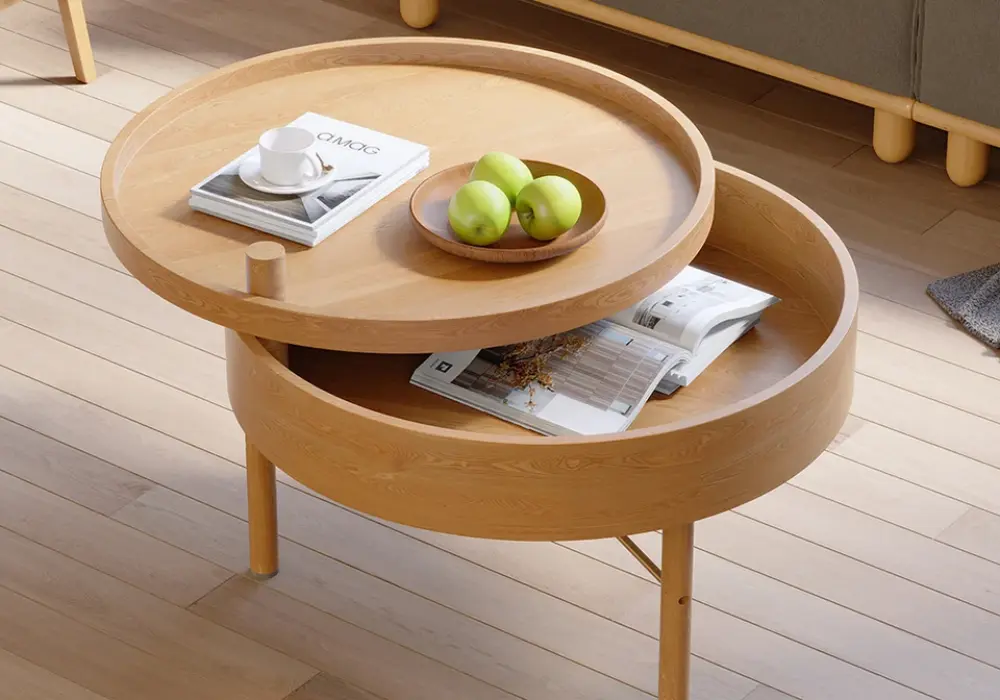
Source Homary
Budget-Friendly vs. Higher-End Styling
You do not need an expensive coffee table or designer accessories to create a cohesive arrangement.
At a lower budget, focus on proportion rather than brand. A secondhand wooden table can be refinished, while affordable books, a simple ceramic vessel and a plant can provide enough visual layering.
At a higher budget, the investment can move toward the table itself: solid wood construction, stone tops, premium finishes, integrated storage or custom dimensions.
A useful budget hierarchy is:
First: correct table size and height Second: durable construction Third: useful storage Fourth: decorative accessories Fifth: seasonal accents
This order prevents spending heavily on styling objects while overlooking the furniture's basic functionality.
Seasonal Styling Without Rebuilding the Whole Table
Seasonal changes should be simple.
For spring, introduce greenery and lighter ceramic pieces. Summer can use natural textures such as woven trays or lighter wood. Fall can bring in warmer colors, pumpkins or textured vessels. Winter can shift toward candles, darker ceramics and subtle greenery.
Store seasonal accessories in labeled bins rather than leaving them scattered throughout the home. A small collection of interchangeable pieces is usually more practical than buying an entirely new arrangement every few months.
The goal is to change the accent layer, not the entire composition.
How to Style a Coffee Table Without Sacrificing Function
Source Homary
Ultimately, a coffee table should connect three things: proportion, usability and visual balance.
Before purchasing one, measure the sofa length, seat height, available floor area and circulation paths. Then select a table that fits those measurements. Once the furniture is correctly sized, use trays, books, plants and decorative objects to establish visual layers.
A well-designed coffee table should allow someone to sit down, reach a drink, put down a book and walk around the room without moving half the decor.
That is why the best coffee table styling is not necessarily the most elaborate. It is the arrangement that looks intentional while still supporting everyday life.
If you are choosing a new coffee table, create a simple measurement sheet first: sofa length, sofa seat height, available table length, desired table height, sofa-to-table distance and main walking clearance. Taking those measurements before shopping can eliminate many of the proportion problems that become obvious only after delivery.
Ready to plan your living room? Use a printable coffee table measurement and styling checklist to compare dimensions, spacing and storage needs before you buy. Once the measurements are clear, you can narrow your choices by shape, material, storage and style instead of shopping by appearance alone.
FAQ
What size coffee table should I choose for my sofa and how far should it sit from the couch?
A useful starting point is a coffee table approximately two-thirds the length of your sofa. For most living rooms, leave about 14–18 inches between the sofa and coffee table. In compact spaces, a clearance closer to 12 inches may work if it does not restrict legroom or circulation.
How can I layer items on a coffee table so it looks styled but still functional?
Use a combination of low, medium and high objects. A shallow tray can form the base, books can provide a medium layer, and a vase or plant can provide height. Keep a meaningful portion of the tabletop open so there is still room for drinks, remotes and books.
What are safe, durable coffee table decor ideas for homes with young children or pets?
Choose stable, heavier accessories with rounded edges and avoid fragile objects near the table edge. Solid wood, durable metal and scratch-resistant surfaces are generally practical choices. Low bowls, books, sturdy trays and secured decorative vessels are safer than lightweight sculptures or thin glass accessories.
How do I create a focal centerpiece without making the table feel cluttered or too large?
Choose one dominant centerpiece and build around it with smaller, lower objects. For most tables, a focal object around 8–14 inches high can create enough vertical interest without dominating the room. If it blocks sightlines from the sofa, reduce its height.
How often should I rotate seasonal decor on my coffee table, and where should I store off-season pieces?
There is no required schedule, but rotating accents three to four times a year is an easy approach. Store seasonal pieces in labeled containers so the core tabletop arrangement—such as the tray, books and primary vessel—can remain consistent.
Can I style a coffee table on a tight budget—what are affordable swaps and easy DIY options?
Yes. Start with the table's size and placement rather than expensive accessories. Secondhand furniture, simple ceramic vessels, inexpensive plants, books and DIY trays can create a layered look at a relatively low cost. Refinishing a solid-wood secondhand table can also be more valuable than replacing a structurally sound table simply for appearance.