

A rug does not have to go under a TV stand. In many living rooms, it works better beneath the seating group and stops before the console, leaving a visible strip of flooring. Extending it under TV stands can also work when the rug is large enough and the furniture remains stable. The decision depends on the room’s proportions, the cabinet’s support points, and how you use the surrounding floor.
Treat this as a layout choice, not a rule about matching furniture. The rug should help organise the room without making the console uneven, obstructing access, or creating an awkward edge across a walking route.
Table of Contents
Decide What Area the Rug Is Defining
Most living-room rugs visually gather the sofa, chairs, and coffee table into one seating area. The television wall can remain outside that area and still feel connected through colour, material, and alignment. A gap between the rug and the console is therefore perfectly reasonable.
In another room, a large rug may cover almost the entire furniture arrangement. If it reaches the television wall naturally, the console can sit on it, provided the support and clearance requirements are satisfied. The goal is a coherent room, not stopping at a predetermined furniture boundary.
Begin by looking at the room from the entrance. Does the rug define a usable seating group, or does it look like a small island beneath the coffee table? Adjusting the rug in relation to the sofa may improve the room more than moving it closer to the TV stand.
Compare the Three Main Arrangements
Rug arrangement | When it can work | What needs checking |
Stops before the console | The rug defines the seating group | The exposed floor looks intentional and the edge is outside the main route |
Fully under the console | A large rug unifies most of the room | All required supports rest evenly and doors or drawers work |
Partially under the console | A specific layout requires overlap | No support is left at a different height or perched on a bound edge |
The third arrangement deserves particular care. A console that spans a rug edge can have some supports on the pile and others on the floor. Depending on the support design and rug thickness, that can make the furniture rock, twist, or sit out of level.
Do not correct an unstable arrangement by improvising under one leg. Reposition the rug or furniture and follow the cabinet’s levelling instructions. The console’s stability matters more than whether the rug reaches a preferred visual line.
Room-by-Room Rug Placement
The right rug placement depends on your room size, seating arrangement, and how much floor space you want to leave around the TV stand. Here are a few practical approaches for different living spaces.
Small Living Rooms
In a compact living room, keeping the TV stand on the bare floor often makes the space feel less crowded. A 1524 × 2438 mm rug (152 × 244 cm) can work as a starting point for a smaller seating area, provided it accommodates the main furniture comfortably. Position the rug beneath the front legs of the sofa when possible, and leave a visible strip of flooring between its edge and the TV stand.
Medium-Sized Living Rooms
A 2438 × 3048 mm rug (244 × 305 cm) is a common starting point for a medium-sized seating arrangement. Ideally, the rug should connect the sofa, accent chairs, and coffee table into one visual group. It can stop before the TV stand or extend beneath it if the rug is large enough to support every contact point evenly.
Large and Open-Concept Living Rooms
A 2743 × 3658 mm rug (274 × 366 cm) or larger can help define the living area within an open floor plan. Rather than positioning the rug solely around the TV stand, align it with the main seating group. If it reaches the media console, make sure the entire base or all support points sit evenly on the rug.
Dedicated Media Rooms
In a media room, prioritise the seating rows and walking paths when positioning the rug. The TV stand can remain on hard flooring, which also makes cable access and cleaning easier. If you prefer the rug underneath the console, check its support points and storage clearance before finalising the layout.
Check the Base Before Choosing the Rug Position
A cabinet with individual legs meets the floor differently from one with a broad plinth or several separate base sections. Look at all the actual contact points. A long cabinet can have supports near the centre that are easy to miss when planning from a front photograph.
For an extendable console, consider the final configuration. Moving a section outward may place a support beyond the rug or onto its edge. Set the furniture’s width first, then check the complete support arrangement. Do not assume that a rug position suitable for the compact setup will work after extension.
If a TV rests on the cabinet, follow the TV and furniture instructions for support and securing. A rug does not provide stability or replace anchoring where required. Confirm that the furniture is level and that all intended support points bear properly before adding equipment.
How to Choose the Right Rug Size and Distance from a TV Stand
There is no fixed rule for how far a rug should sit from a TV stand. The right spacing depends on the room layout and the size of your furniture. Use these measurements as practical starting points:
- Rug size: Choose a rug based on the seating area rather than the TV stand alone. When space allows, let the rug extend approximately 152–305 mm (15–30 cm) beyond each side of the sofa.
- Distance from the TV stand: If the rug stops before the console, leaving around 152–305 mm (15–30 cm) of visible flooring can create a deliberate separation. Adjust the gap to suit the room rather than treating it as a strict requirement.
- Full placement under the console: Make sure all legs, feet, or base supports rest fully on the rug. Avoid positioning a support directly on the rug's bound edge.
- Partial placement: Be cautious when only part of the console overlaps the rug. If some supports sit on carpet while others remain on hard flooring, the difference in height may affect stability.
A Simple Way to Test Your Layout
Before settling on a rug position, follow these steps:
- Measure the seating area, sofa, and TV stand, including the console's full width if it is extendable.
- Use painter's tape to mark the proposed rug dimensions and position on the floor.
- Check how the rug aligns with the sofa, chairs, and coffee table.
- Move the TV stand into its intended position and inspect every support point.
- Open the drawers or cabinet doors and check walking paths, cable routes, and cleaning access.
The best arrangement is one that looks balanced while keeping the TV stand level and the surrounding space practical to use.
Choose a TV Stand That Fits Your Rug Layout
Your TV stand's dimensions and base design can influence where your rug should end. Whether you prefer an extendable console or a fixed-width design, consider the furniture's final footprint before deciding on rug placement.
Extendable TV Stands for Flexible Layouts
If your living room layout may change, an extendable TV stand offers more flexibility. However, remember to plan around its full extended dimensions rather than its shortest configuration.
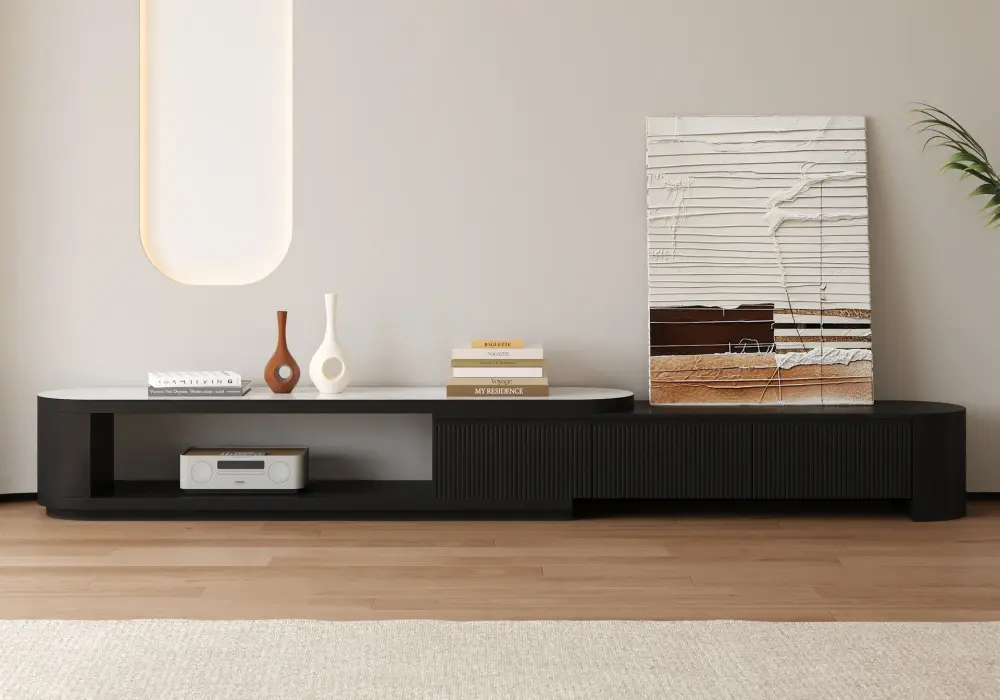
The Velar Extendable TV Stand features three drawers and a fluted design. Before placing a rug underneath, extend the console to your preferred width and check that all support points remain properly positioned.
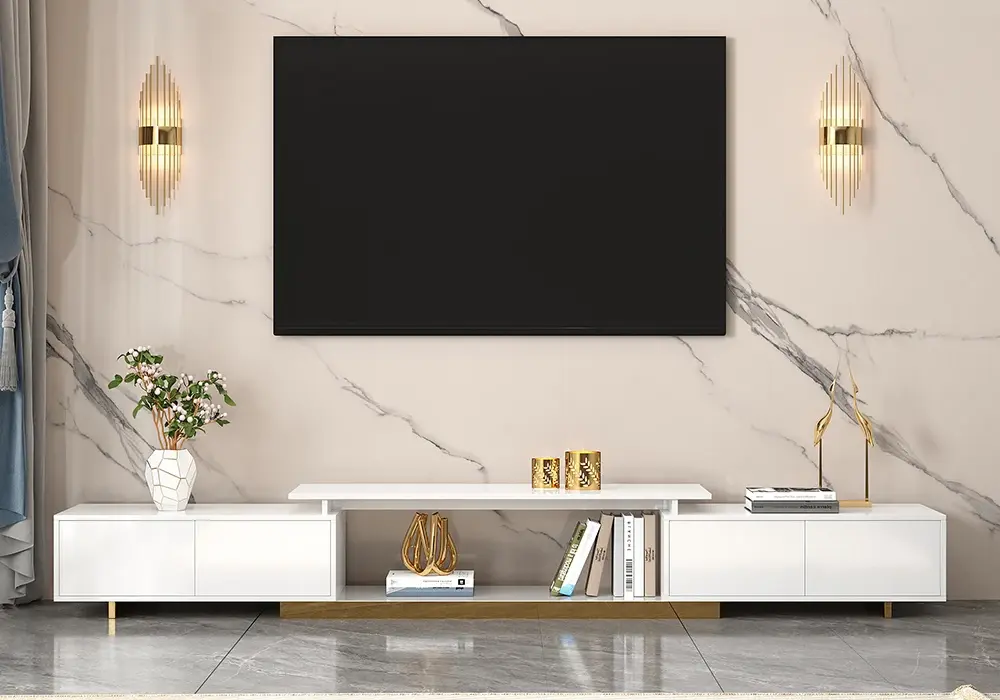
For a storage-focused option, the Mordel Extendable TV Stand features hidden storage and an adjustable width. Decide on its final configuration first, then plan the rug around the console's actual dimensions and make sure its storage remains easy to access.
Fixed-Width TV Stands for Predictable Placement
A fixed-width console makes it easier to plan your furniture arrangement in advance because its overall dimensions remain consistent.
The Larvo Ash Wood TV Stand offers a defined footprint with a warm wood finish and sintered stone top. Its fixed width makes it easier to measure the surrounding floor space and decide whether the rug should stop before the console or extend underneath it.
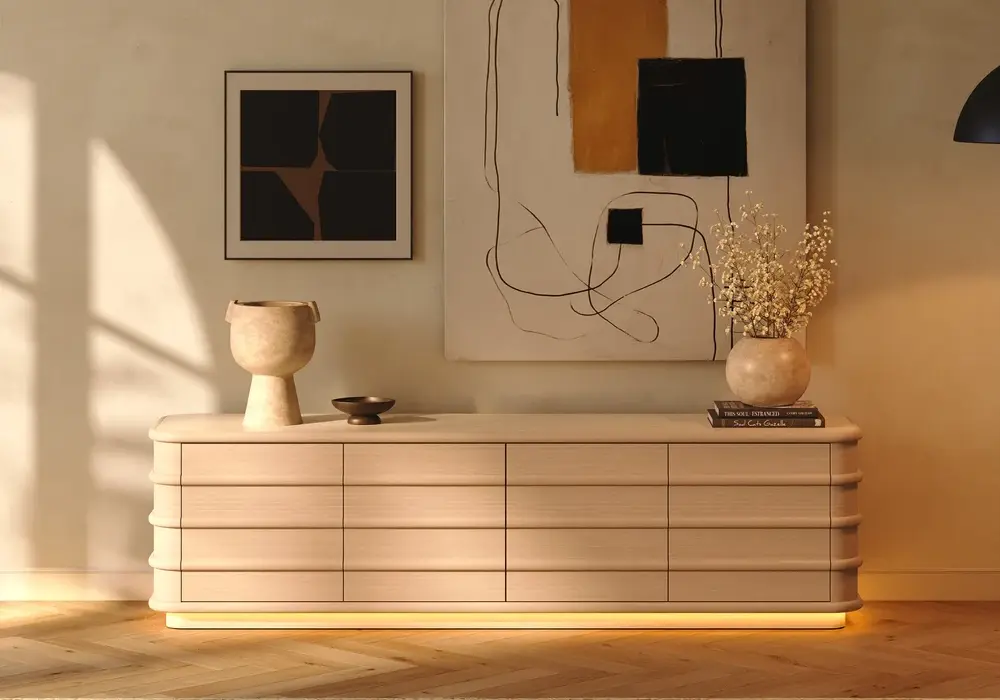
Before choosing full rug coverage, check the actual base dimensions and support positions to ensure the cabinet sits evenly.
These TV stands offer different approaches to organising your media area. The right rug placement ultimately depends on your room dimensions, furniture support points, and preferred layout.
Consider Pile, Pads, and Everyday Access
A thick pile and thick pad can change how a console sits. They may also affect clearance beneath low doors or drawers if the rug extends into their travel. Check those movements after positioning, rather than assuming a closed cabinet photograph proves adequate space.
Use a pad appropriate to the rug and floor, following the relevant care instructions. Avoid building up several layers to make one support reach the same height as another. If the furniture is unstable, change the arrangement instead of treating the rug system as a levelling device.
Think about cleaning, too. A rug trapped beneath a long, heavy console can be harder to rotate or remove. If you expect frequent cleaning or seasonal rearrangement, leaving the console on the hard floor may be more convenient. Check that vacuum access remains practical around the cabinet and cables.
Keep Cable Routes Independent of the Rug Decision
Do not extend a rug simply to hide electrical cords. Plan equipment wiring through appropriate routes and follow the device instructions. A loose lead concealed under a rug can be damaged or become difficult to inspect, and the rug edge may still create a trip point.
If the console includes lighting, allow for its cable as well as television and audio equipment. Recheck the route when adjusting an extendable section. Furniture movement should not pull the connection tight or trap a cable beneath a support.
Finish the layout by testing the room as you use it: walk from the entrance, sit down, open the console storage, and clean around the rug edge. Choose the arrangement that stays level, gives the seating group a clear shape, and works without constant adjustment.
Frequently Asked Questions
Is it wrong to leave the TV stand off the rug?
No. Keeping the television wall on exposed flooring is a common practical arrangement. The rug can define the seating area while the console remains connected through the room’s overall palette and furniture placement.
Can only the front legs sit on the rug?
Check the furniture’s stability rather than following that rule automatically. If front and rear supports end up at different heights, the console may not sit properly. A clear gap or full, even support can be a better arrangement.
Should the rug be wider than the TV stand?
Not necessarily. Choose the rug primarily for the area it defines and the furniture it supports. A rug beneath the seating group does not have to match the console’s width, particularly when the television wall sits outside it.
Is a low-pile rug better beneath a console?
A lower pile may simplify positioning and clearance, but it does not guarantee stability. Check the pad, rug edge, floor, and every support point. The furniture should remain level in its final configuration.
What if my rug almost reaches the TV stand?
Avoid leaving a support perched on the binding. Move the rug to create a deliberate gap or a stable overlap, then reassess the seating arrangement. A small positional change can be more useful than forcing the edge beneath the cabinet.