

The best small space Christmas décor starts with one focal point, one tight colour palette, and a walkway you never block. Pick a single surface to carry the season, such as a narrow console or a bench from a well-chosen entryway furniture collection, and keep everything else in the room calm.
That approach works because a small flat does not have the floor area to hold a full holiday setup. When every shelf, sill, and tabletop gets a few ornaments, the room reads as clutter. When one spot gets a complete scene, it reads as a decision. The sections below show how to choose that spot, build the display, and still have room to live, host, and put everything away in January.
Table of Contents
The Quick Answer: Five Rules for Small Space Christmas Décor
If you only have ten minutes before deciding what to buy or unpack, use these five rules:
- Choose one main display location. A console, a bench, a shelf, or a single window is enough.
- Limit the palette to one seasonal accent and one supporting neutral or metallic. Everything you add should belong to that pair.
- Protect your daily routes. The path from the door to the seating, kitchen, and bedroom stays open, with doors fully swung and chairs pulled out.
- Swap, do not stack. Store a few everyday accessories while the seasonal ones are out, so you are exchanging layers instead of adding them.
- Decide the reset before you decorate. Every item needs a defined place to return to, and the whole display should take minutes to take down.
Map the Room Before You Add Anything
Walk from the entrance to the main seats, the kitchen, the bedroom, and the bathroom. Do it with doors open and chairs in their usual positions. A corner that looks empty in a photo is often the space people squeeze through every morning. Treat that space as part of the layout, not as a gap waiting for a garland.
Next, choose the view that should carry the season. This is the first thing you see when you walk in, or the spot you look at from the sofa. Give that view enough attention to feel finished, then keep every other location quieter. A single repeated colour elsewhere, such as a throw pillow cover or a ribbon on a cabinet handle, is enough to connect the room without creating a second full display.
Finally, decide what will temporarily leave. If the console is going to hold a seasonal scene, the mail, keys, and everyday bowls need a different home for a month. This trade is usually more useful than adding decorations on top of everything already there. Keep the displaced items somewhere accessible, and store fragile ones in a way that suits their materials.
Pick a Palette That Belongs to Your Flat
Start with what is already in the room: the sofa, the rug, the wall colour, and the wood tone of your furniture. Choose one seasonal accent that works with them and one supporting detail. A restrained palette separates deliberate decoration from the ordinary visual noise of flat storage.
Here are three combinations that suit small rooms:
- Warm wood, cream, and deep green. Natural branches, a simple wreath, and ceramic or wooden ornaments sit well on walnut and oak tones.
- Brass, ivory, and a single red. Metallic details add sparkle without needing many lights, and one red element keeps the scheme from feeling flat.
- Soft neutrals with a pale blue or silver accent. This works in light, minimalist rooms where heavy colour would feel out of place.
Repeat the palette at different scales. A larger textile in the seating area can echo a smaller arrangement on a shelf. The ornaments do not need to match from place to place, only the colours. Leave enough surface visible that the flat still looks like a home rather than a temporary display. Keep shipping boxes and supply bags out of the main room as well: unpack one project, finish it, and put the remaining materials away. A small space can feel crowded by the process of decorating long before the decorations themselves are too much.
Choose Your Focal Point
The surface you pick sets how much you can do. This quick comparison shows how common small-space options behave:
Focal point | Footprint | Works best when |
Narrow console table | Small, against a wall | You have an entry wall or hallway with a little depth |
Entryway bench | Small to medium | Guests arrive with coats and boots, and you want the entrance to feel festive |
Existing shelf | None added | You can clear a section and keep the rest quiet |
Window sill | None added | The sill is deep enough and away from heaters |
Compact tabletop tree | Small, on a stable surface | You want a tree without a floor stand |
Whatever you choose, the surface must be stable and suited to the load. Do not stack furniture or use a narrow ledge to make up for missing floor space. A lower arrangement with open space around it often looks more intentional than a tall one that wobbles.
Turn a Console Table Into Your Christmas Display
A console is one of the most useful pieces for small space Christmas décor because it creates a defined stage without taking up much of the room. Against a wall, it frames a scene the way a mantel would. If you are shopping for one, the 991 mm mid-century modern console table is an example of the type: clean lines, a walnut finish, and an open top surface for displaying décor, on a solid wood frame that is described as light enough to relocate easily.
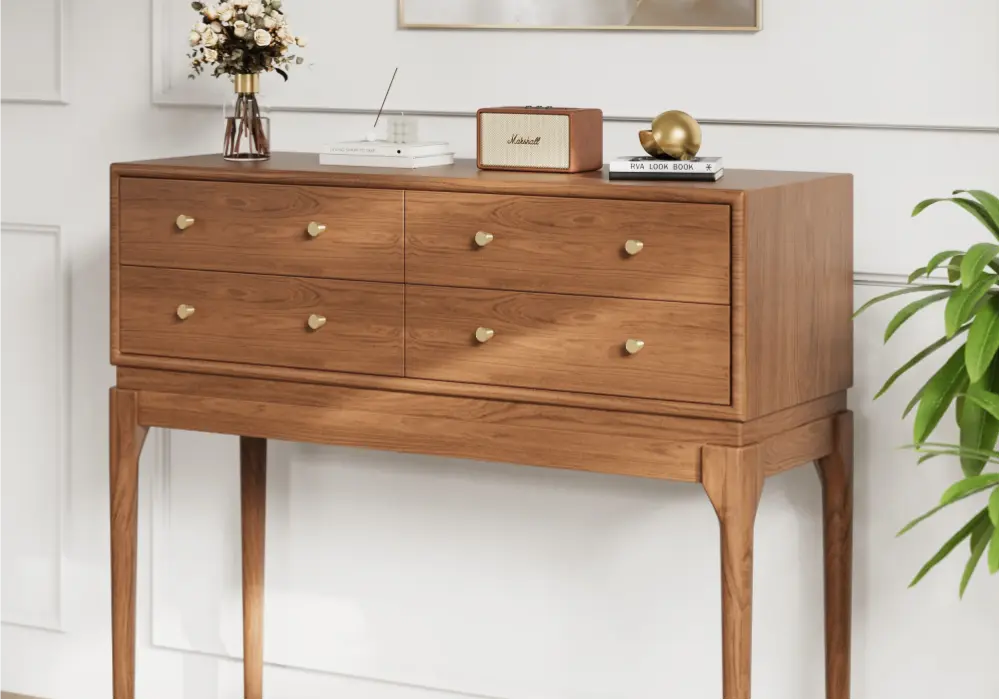
The four front drawers matter as much as the top. They give the displaced items from your daily routine, along with seasonal extras such as spare light strings, extension cords, ribbon, and wrapping paper, a place that is out of sight but close at hand. That keeps the surface itself clear for the scene.
A simple, repeatable console setup looks like this:
- An anchor object. Choose one larger piece, such as a compact tabletop tree, a wreath leaned against the wall, or a vase of cut branches.
- A light source. A single string of warm lights, or a small lamp, sets the mood after dark.
- Two or three supporting accents. Think a few ornaments, a small bowl, or a framed card, in your chosen palette.
- Open space. Leave visible bare surface around the grouping so it reads as a scene and not a pile.
Walnut tones pair naturally with deep green, brass, and cream, so the palette above can be built almost from the table itself. Because the grouping lives on one surface, you can lift it as a unit when you need the space for hosting, and set it back afterward in a minute or two.
Add a Storage Bench for Guests, Boots, and Wrapping
In winter, the entrance of a small flat is where the most clutter lands: boots, bags, coats, and gift bags. A bench with storage handles that while also giving the entrance a place to carry the season. The 1194 mm walnut entryway bench combines a left-side cabinet for trainers and boots with a padded cotton and linen seat, in a modern minimalist style.
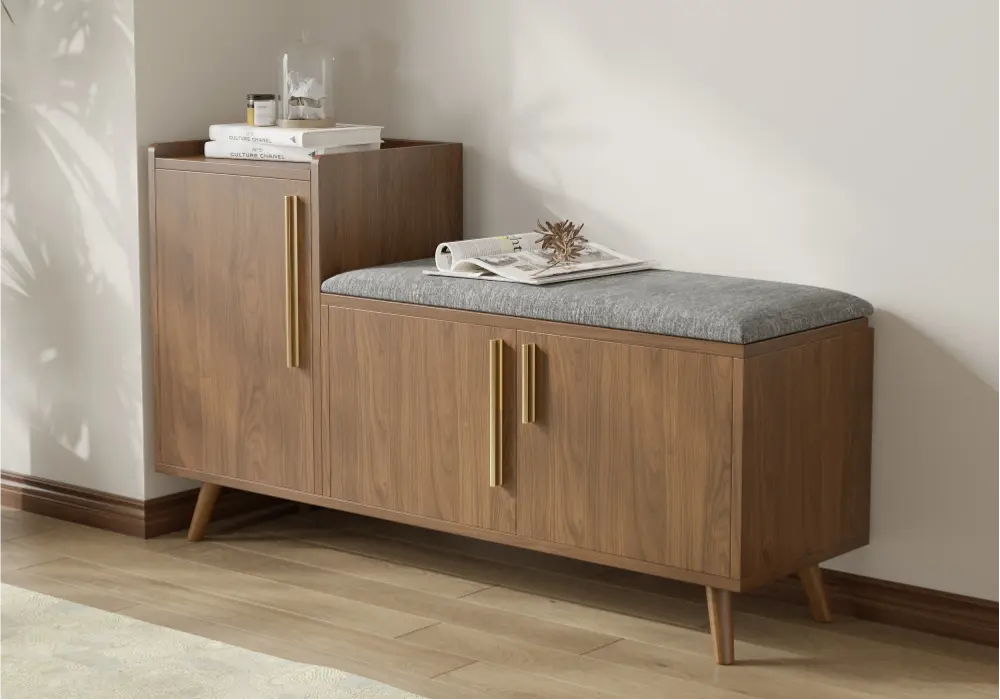
That combination helps in three ways during the holidays:
- Guests have a place to sit and change shoes. That keeps wet boots off the rug and the entry route clear.
- The cabinet and shelves hide everyday overflow. Footwear moves out of sight, so the entrance does not compete with the décor.
- The seat can hold a small seasonal touch. A neatly folded throw in your accent colour or a single small arrangement ties the entrance to the rest of the room, as long as it can be lifted off quickly when someone needs to sit.
Do not fill storage with seasonal supplies until you have checked what you need to keep there every day. A cabinet crammed with boxes of ornaments stops being useful on the first snowy morning. If you are comparing benches, measure the door swing and the walkway beside it first, and choose the piece that fits the route you actually use.
No-Tree Ideas That Still Feel Complete
A Christmas tree is optional. If floor space is tight, a no-tree scene can feel just as festive when it is treated as a complete design choice rather than a smaller version of a big-room setup.
- Branch and light arrangement. A tall vase of bare or evergreen branches, with a warm light string and a few lightweight ornaments, creates height without a floor stand.
- Wreath as the anchor. Hang a wreath on a wall or lean it behind a console, and echo its colours in a nearby textile.
- Garland on an existing shelf. Lay a short garland along the front of one shelf and keep the rest of the shelves unchanged.
- Window moment. If the sill is deep, stable, and away from any heater, a small row of lights and a few ornaments can make the view from outside as pleasant as the one inside.
In every case, build height only where the placement is stable, and echo the focal point's colours in one other detail so the room feels connected without creating more locations to maintain.
If You Want a Small Tree, Plan the Base and the Lights
A small tree can work well in a tiny room, but plan its base, its water, and its electrical needs before you start decorating. The National Fire Protection Association advises keeping a tree at least 914 mm from any heat source, such as radiators, fireplaces, candles, heat vents, or lights. It also says the tree should not block an exit, and that a cut tree needs fresh water added to the stand every day. In experiments by the National Institute of Standards and Technology, a watered tree did not ignite under the same ignition source that set a dry tree alight.
For electrical safety, use light strings that carry the label of a recognised testing laboratory, and check whether each string is rated for indoor or outdoor use. NFPA data also points to electrical problems as a leading cause of home tree fires, so inspect cords before use and do not run them through places where they will be pinched or stepped on. In a small flat, a smaller tree does not make a blocked route or an unsafe light string acceptable. If a 914 mm clearance from a heater is not possible in the room, choose a tabletop display or one of the no-tree options above instead.
Use Vertical Space Without Creating New Obstacles
Wall and shelf space can take pressure off the floor plan, as long as it does not turn into a new set of obstacles.
- Shelves. Use one shelf, or part of one, for a seasonal accent. Check that the shelf is suited to the load and that each object sits securely. Keep room for books and everyday items, and avoid lining every edge with decorations that must be moved to reach something behind them.
- Walls. Follow the mounting product's instructions and your lease or property rules. Removable adhesives are not suited to every paint, finish, or weight, so test before you commit and use them only as directed.
- Hanging items. Keep them away from doors, controls, and equipment. Look at the room from normal walking height to confirm that nothing projects into a narrow route. Vertical décor should reduce the pressure on the floor, not move the obstruction up to head or shoulder level.
Host in a Small Space Without Overloading the Room
Decide how the gathering will work before you set out food. If the layout allows, keep one area for serving and another for sitting. Clear the surfaces you will need for plates and drinks, and move the decorative grouping to its planned temporary place. This is where a console or bench scene that can be lifted as a unit pays off.
Use furniture for its intended purpose. A console is not a dining table and a storage bench is not a dining seat just because space is limited, so follow each piece's intended use and load guidance. If the room cannot support a seated dinner, adjust the service style, such as a buffet-style spread or a staggered arrival, instead of improvising unsupported furniture functions.
Put personal belongings and unnecessary accessories away before visitors arrive. A clear place for coats and bags is more welcoming than another seasonal arrangement, and a storage bench by the door can do that job. Give guests an easy, understandable route through the flat, and keep every exit unobstructed.
Plan the Reset as Well as the Gathering
A display you can restore in a few minutes is more enjoyable than one that needs constant rearranging. Choose decorations that return to one defined location when the season ends, ideally the same drawer or cabinet you used during the month. Wrap fragile pieces as you remove them, keep light strings coiled and labelled, and return the everyday items you set aside. If the reset is simple, the next year's setup will be too.
Frequently Asked Questions
How do I decorate a small flat for Christmas?
Choose one main focal point, such as a console table, a bench, or a shelf, and build a complete scene there. Repeat its palette in two or three smaller details elsewhere, keep your daily routes clear, and store a few everyday accessories while the seasonal ones are out.
How can I decorate for Christmas without a tree?
Use an existing stable surface as the display location and give it a clear anchor, such as a wreath, a vase of branches, or a garland, with a warm light string and a few supporting accents. Connect it to the room with one repeated colour, and let it feel complete on its own.
How do I avoid clutter when decorating a small space?
Limit yourself to one or two display locations and define the footprint of each. When you add something to a full surface, remove something else. Keep boxes and unused supplies out of the room while you work, and keep storage for seasonal items separate from storage you rely on daily.
What furniture works best as a holiday focal point in a small room?
A narrow console table or an entryway bench is often the most practical choice, because it creates a defined spot for the scene without a large footprint. Drawers or a cabinet help you hide everyday overflow and seasonal supplies. Measure the piece and the route around it before you buy.
How far should a Christmas tree be from a heater or radiator?
The National Fire Protection Association recommends keeping a tree at least 914 mm away from heat sources such as radiators, fireplaces, candles, and heat vents. A cut tree should be watered daily and should not block an exit. If the room cannot meet that clearance, a tabletop or no-tree display is the safer option.
How can I host Christmas dinner in a small space?
Plan seating, serving, and walking routes first, then reduce the decorative footprint to fit. Move the display to its temporary spot, keep useful surfaces clear, and use each piece of furniture for its intended purpose.