

Why is patio furniture so expensive? A simple outdoor sofa or dining set can cost as much as — or even more than — indoor furniture. The price isn't just about markup. Outdoor furniture needs to withstand sun, rain, humidity and temperature changes, which often means better materials, protective finishes and weather-resistant fabrics.
Then there are less obvious costs, including manufacturing, bulky shipping, storage, delivery, warranties and retailer overhead.
In this guide, we'll break down where your money goes, how popular patio materials compare, what drives prices up, and how to save without sacrificing quality.
By the end, you'll know what a fair patio furniture price looks like.
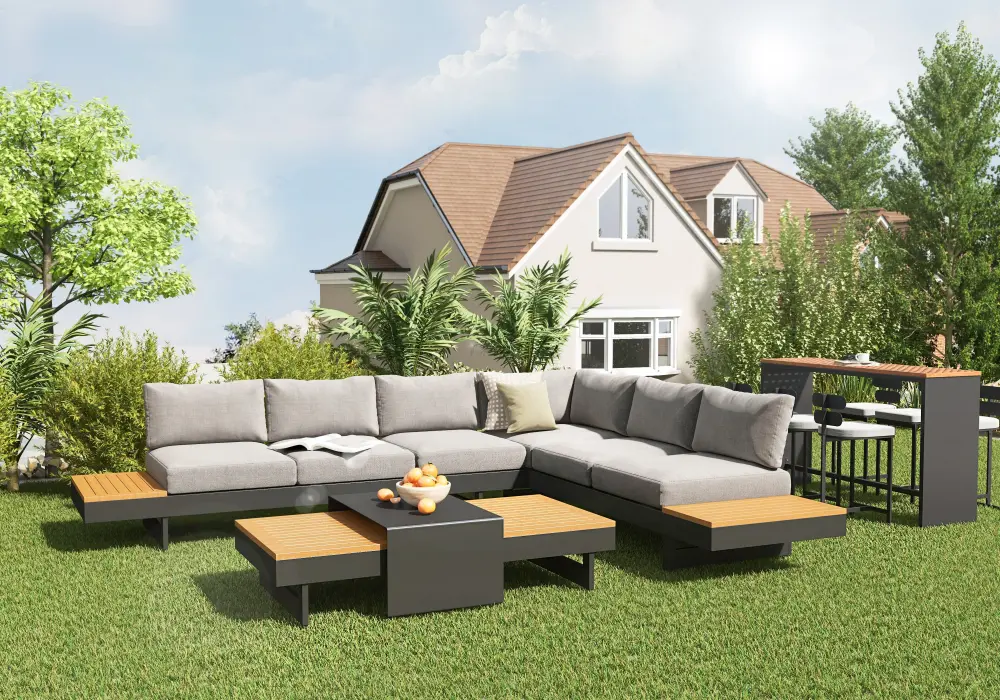
Outdoor Teak & Aluminum Modular Sofa Set of Homary
What You're Really Paying For: A Full Price Breakdown
When you see a $2,000 patio set, that money doesn't go directly to the materials.
A finished outdoor furniture set carries costs at almost every stage of its journey, from raw materials and manufacturing to packaging, transportation and the final sale.
Here's an illustrative breakdown for a six-piece outdoor dining set priced at $2,000:
Cost component | Typical share | Example on $2,000 |
Raw materials | 25–35% | $500–$700 |
Manufacturing & labor | 12–20% | $240–$400 |
Finishing & weather protection | 5–8% | $100–$160 |
Cushions/filling | 5–10% | $100–$200 |
Packaging | 3–6% | $60–$120 |
Freight & logistics | 8–15% | $160–$300 |
Retail overhead & margin | 15–25% | $300–$500 |
Warranty/service reserve | 2–5% | $40–$100 |
These are broad planning ranges rather than universal industry percentages. Costs vary substantially by country, brand, product design and material.
Raw materials aren't the whole story
Take an aluminum patio chair. The manufacturer may need to cut and weld the frame, smooth the joints, apply a powder-coated finish, install hardware and inspect the finished product.
A teak chair has its own cost structure. The wood must be properly graded and machined, while more complex designs require additional labor. Synthetic wicker and rope furniture can also be surprisingly labor-intensive because weaving and tensioning take time.
Cushions add another layer. Outdoor cushions may use quick-drying foam, water-resistant liners, UV-resistant thread and performance fabrics. That is very different from putting an ordinary indoor cushion outside.
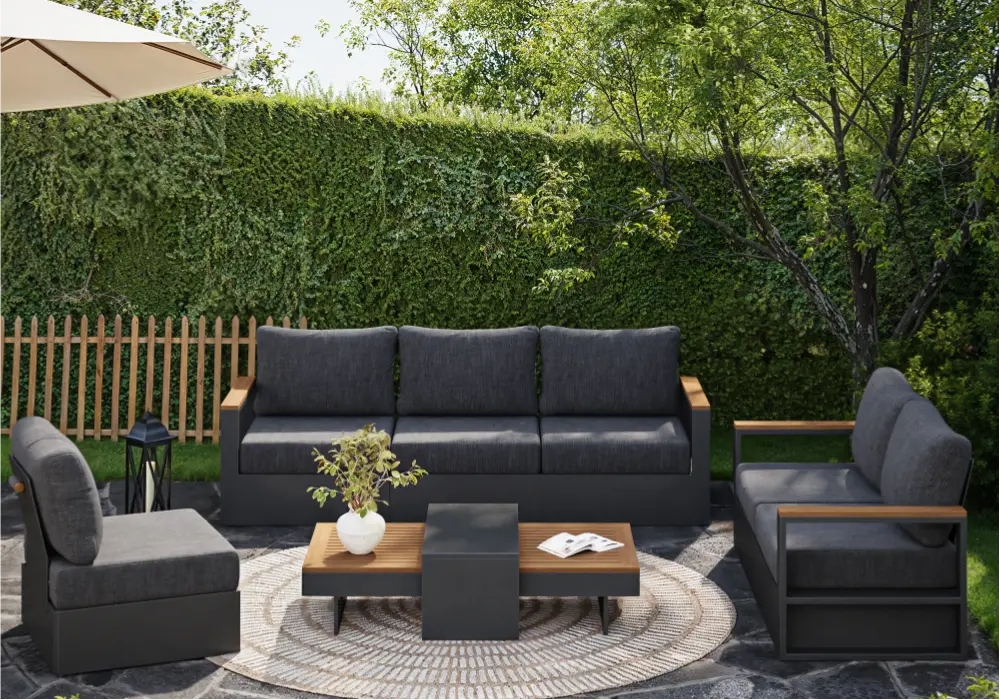
Convertible Outdoor Sectional Sofa Set of Homary
You're also paying for protection
Outdoor products need more than attractive finishes. Powder coating, sealants, corrosion-resistant hardware and UV-resistant materials are all designed to slow weather-related deterioration.
Packaging is another overlooked expense. Patio furniture is often bulky rather than exceptionally heavy. A sofa or large dining table can consume substantial shipping space, increasing freight costs from the factory to a warehouse and then to your home.
Finally, retailers have to account for returns, damaged products, customer service, storage and warranties.
So when you're asking, "Why is patio furniture so expensive?", the better question is:
How much of this price is paying for useful durability, and how much is paying for branding or retail overhead?
That's where material and construction comparisons become important.
Material Matters: Comparing Cost and Lifetime Value by Type
The cheapest patio furniture isn't necessarily the best value, and the most expensive isn't automatically the most durable.
Your climate, usage, maintenance habits and expected lifespan all matter.
Patio Furniture Materials Compared
Material | Typical set price* | 5–10 year maintenance budget | Expected life | Climate suitability |
Teak | $1,000–$4,000+ | $100–$400 | 15–25+ years | Excellent overall |
Aluminum | $500–$3,000+ | $50–$250 | 10–20 years | Humid, coastal, hot |
HDPE/resin wicker | $500–$2,500+ | $50–$250 | 8–15+ years | Humid, sunny |
Wrought iron | $600–$2,500+ | $150–$500 | 10–20 years | Dry/covered areas |
Steel | $400–$2,000+ | $150–$500 | 5–15 years | Best with corrosion protection |
Rope | $700–$3,000+ | $75–$300 | 5–10+ years | Moderate climates |
Performance fabric | $100–$500+ per cushion set | $50–$200 | 5–10+ years | Sunny, high-use patios |
*Broad retail estimates in U.S. dollars. Actual prices vary considerably by design and market.
Teak: high upfront cost, long-term potential
Teak is famous for outdoor use because it naturally performs well in changing weather conditions.
The downside is price. High-quality teak furniture is expensive because the material itself has significant value, and producing well-finished furniture takes skill.
Its long lifespan can make the initial expense easier to justify. A $2,000 teak set that lasts 15 years may be cheaper over time than repeatedly replacing $700 sets.
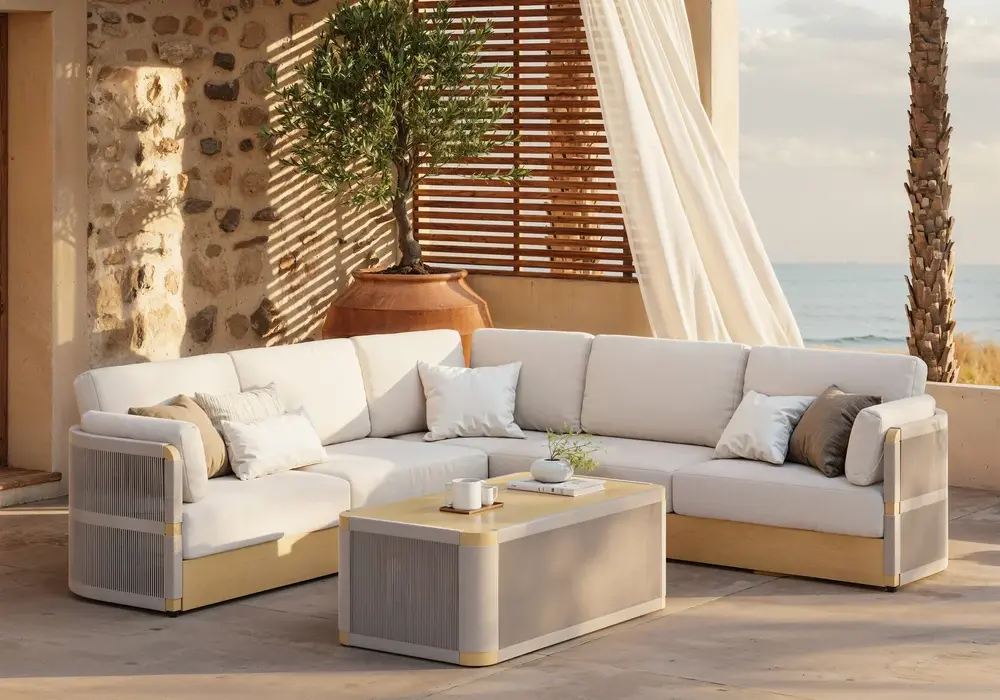
Handwoven Rope L-Shaped Outdoor Sofa of Homary
Aluminum: one of the best all-around values
Aluminum is lightweight, versatile and naturally resistant to rust compared with conventional steel.
It's particularly useful in humid climates because you don't have to worry about the same type of iron corrosion found with untreated steel. A good powder-coated aluminum frame can provide years of service with relatively little maintenance.
When comparing aluminum furniture, don't just look at color or styling. Check frame construction, weld quality, hardware and overall sturdiness.
HDPE and resin wicker: choose quality carefully
"Wicker" describes a weaving style, not necessarily a material.
Outdoor furniture commonly uses synthetic resin or HDPE woven around a frame. Better-quality materials are designed to resist UV exposure and moisture, while cheaper plastics may become brittle, fade or crack.
This is one area where paying slightly more for better material specifications can save money later.
Steel and wrought iron: strong but maintenance-sensitive
Steel can be very strong and affordable, but exposed steel is vulnerable to corrosion.
A protective coating can make a major difference. Once that coating is chipped, however, moisture can reach the metal underneath.
Wrought iron can last for many years, but it generally needs more attention than aluminum, especially in wet environments.
Don't ignore cushions and fabric
Sometimes the frame isn't the expensive part.
For furniture that receives heavy sunlight, upgrading to a quality performance fabric may be more valuable than buying a fancier frame. Replacement covers are usually much cheaper than replacing an entire sofa.
Think in cost per use
Suppose a budget patio set costs $700 and lasts five years, while a premium set costs $2,100 and lasts 15 years.
If you use the budget set 80 times per year, its purchase cost works out to about $1.75 per use.
If you use the premium set 100 times per year, its purchase cost works out to about $1.40 per use.
That's why expensive patio furniture can sometimes be the cheaper choice in the long run.
Behind the Price Tag: Manufacturing, Shipping, Tariffs & Certifications
Where furniture is made matters, but the relationship between manufacturing location and retail price isn't always simple.
Labor rates differ between countries, but manufacturers also face differences in energy, materials, tooling, quality control, compliance and transportation.
A lower factory wage doesn't automatically mean a lower final price.
Shipping is a major hidden cost
Outdoor furniture has an unusual logistics problem: it takes up a lot of space.
A patio sofa may not be extremely heavy, but its dimensions make it expensive to move. Costs can accumulate across ocean freight, customs, inland transportation, warehousing and final-mile delivery.
For example, imagine a $1,500 patio set with the following simplified cost structure:
Cost | Example |
Factory production | $850 |
International freight & insurance | $150 |
Duties/customs | $100 |
Domestic transportation & warehousing | $150 |
Retail overhead & margin | $250 |
Final price | $1,500 |
In this example, freight, duties and logistics account for roughly 27% of the final retail price.
Actual percentages can be much higher or lower depending on the country of origin, destination, product classification, freight market and applicable taxes or tariffs.
Certifications can affect price too
Certifications don't automatically make furniture better, but credible standards can provide useful information about sourcing, emissions or product performance.
For example, FSC certification can help verify that certified forest products are tracked through the supply chain. That traceability requires auditing and documentation, which can increase costs.
GREENGUARD certification focuses on chemical emissions from products and furnishings. It can be particularly relevant for buyers concerned about indoor or enclosed-space air quality.
Safety and durability standards can also add testing and compliance costs. ASTM publishes standards covering specific categories of outdoor furniture, while other markets use standards such as EN requirements in Europe.
The important takeaway is that certification should be treated as evidence of a defined claim, not as a general guarantee of quality.
A $3,000 patio set isn't automatically better than a $1,500 one simply because it has a certification. But a higher price may be partly explained by documented sourcing, testing and compliance.
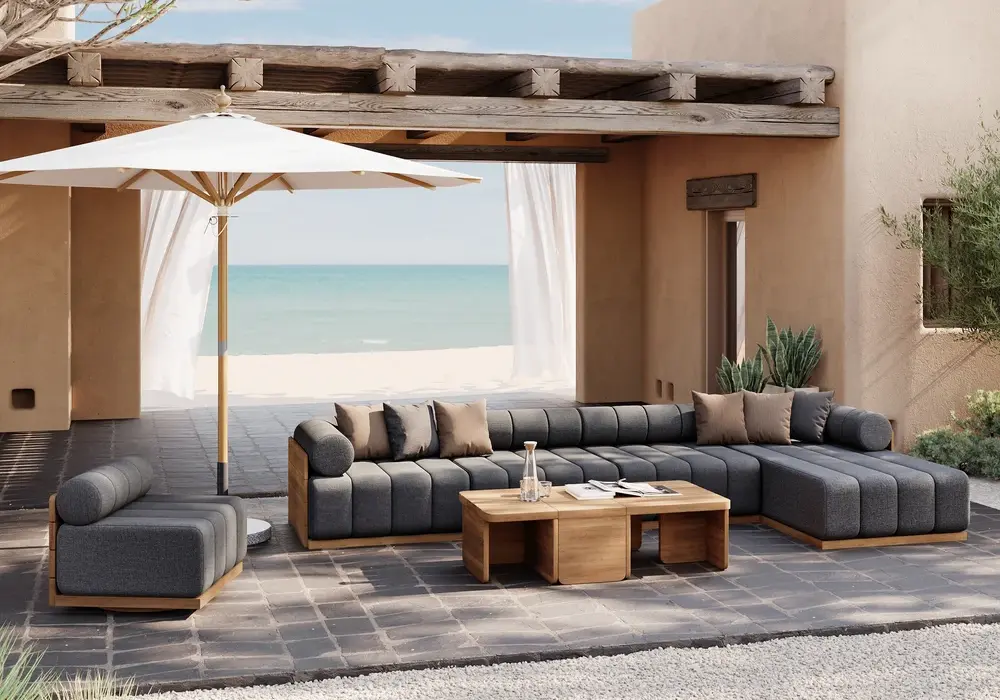
Outdoor Modular Natural Teak Sectional Fluted Sofa Set of Homary
How to Save: Timing, Secondhand Deals, Negotiation & Smart Delivery
You don't need to buy bargain-bin furniture to save money.
Often, timing and careful shopping can make a much bigger difference.
Shop near the end of the season
Outdoor furniture is seasonal, so retailers eventually need to clear inventory.
In many Northern Hemisphere markets, late summer and early fall can be strong periods for clearance discounts. The equivalent buying window in the Southern Hemisphere usually occurs near the end of the local warm season.
Off-season pre-orders can also be worth watching if you're flexible and don't need furniture immediately.
Buy secondhand strategically
Secondhand patio furniture can be an excellent deal, particularly when the frame is still sound.
Look at local resale platforms, estate sales, auctions, used-furniture dealers and community marketplaces.
Before buying, check:
- Frame joints and welds
- Rust and corrosion
- Cracked wicker
- Loose rope
- Warped wood
- Cushion mildew or odors
- Missing hardware
- Availability of replacement cushions or parts
A $300 teak chair that needs cleaning can be a bargain. A $100 steel chair with serious structural corrosion is not.
Negotiate
Negotiation works especially well with floor samples, discontinued collections, open-box items and bulky inventory.
Try:
"If I purchase the entire set today and arrange pickup, is there any flexibility on the price?"
You're giving the seller something valuable: certainty and convenience.
Ask about the real delivered price
A furniture listing price may not be your final cost.
Check whether the quote includes assembly, room-of-choice delivery, stairs fees, packaging removal or old-furniture haul-away.
A $1,200 set plus $300 in delivery and assembly is really a $1,500 purchase.
Consider a DIY refresh
Don't replace structurally sound furniture just because it looks tired.
DIY project | Approximate cost |
Cleaning supplies | $20–$50 |
Paint/coating supplies | $40–$100 |
Replacement hardware | $20–$60 |
Cushion covers | $80–$250+ |
Minor rope/wicker repair | $30–$100 |
Basic refresh | $60–$300+ |
A little maintenance can add years to furniture that would otherwise be discarded.
Is It Worth It? Warranties, Repairs, Resale & Cost-Per-Use
The best way to evaluate expensive patio furniture is to look beyond the purchase price.
Read the warranty carefully
A "10-year warranty" sounds impressive, but you need to know what is actually covered.
Check the coverage period for the frame, cushions, fabric, finish and hardware. Also look for exclusions involving fading, normal wear, commercial use, weather exposure and corrosion.
Some warranties cover replacement parts but not labor or shipping.
Quality furniture can be repairable
One advantage of better-made furniture is that individual components may be replaceable.
Typical repair budgets might include:
Repair | Approximate cost |
New cushion covers | $100–$400+ |
Custom recushioning | $300–$1,000+ |
Teak cleaning/restoration | $100–$400 |
Metal refinishing | $100–$500+ |
Minor wicker repair | $75–$300 |
Replacement hardware | $20–$100 |
Repairing a good frame can be much cheaper than starting over.
Consider resale value
Quality patio furniture can retain some resale value, particularly when it's made from desirable materials such as teak or aluminum and has been well maintained.
A useful planning range is roughly:
- Budget furniture: 10–30% of original price after several years
- Mid-range furniture: 20–40%
- High-quality, well-maintained furniture: 30–60%
These aren't guarantees. Condition, local demand and brand recognition can dramatically change the result.
Use the cost-per-use formula
Here's a simple calculation:
Cost per use = (Purchase price + maintenance + delivery − resale value) ÷ total uses
For example:
A $2,400 patio set
- $300 maintenance
- $200 delivery − $600 resale value = $2,300 net cost
If you use it 150 times a year for 10 years:
$2,300 ÷ 1,500 uses = $1.53 per use
Suddenly, a $2,400 patio set doesn't look quite as outrageous.
The goal isn't to find the cheapest patio furniture.
It's to find furniture where price, durability, maintenance and frequency of use make sense together.
FAQ
What actually makes patio furniture more expensive than indoor furniture?
Outdoor furniture must withstand sunlight, rain, humidity, temperature changes and dirt. Manufacturers may therefore use more durable materials, outdoor-rated fabrics, protective finishes and stronger construction. Bulky shipping can also add significant cost.
How much should I expect to pay for teak, aluminum or resin wicker patio furniture?
Prices vary widely, but a complete set can range from roughly $500 for simpler budget furniture to $3,000 or more for premium products. Teak generally sits toward the higher end, while aluminum and synthetic wicker span a much wider range.
Is expensive patio furniture worth it?
It can be. A more expensive set that lasts 15 years and remains comfortable may have a lower cost per use than a cheaper set that needs replacement every few years.
When is the best time to buy patio furniture?
In many Northern Hemisphere markets, late summer and early fall are strong times to look for clearance deals. In the Southern Hemisphere, the equivalent window generally falls at the end of the local warm season.
Can I save money buying secondhand patio furniture?
Yes. Look for structurally sound frames made from durable materials. Inspect joints, corrosion, wood, wicker, rope, cushions and missing hardware before purchasing.
How do warranties and certifications affect long-term value?
A useful warranty can reduce repair or replacement risk, while certifications may provide evidence about material sourcing, emissions or product testing. However, neither guarantees that a product is worth its price, so always check the specific terms.
What are durable, budget-friendly materials for different climates?
Aluminum and quality HDPE are often practical in humid climates. UV-resistant synthetic materials and performance fabrics work well in intense sun. In freezing climates, choose furniture designed for temperature swings and follow the manufacturer's storage recommendations.