

Mount the TV so the center of the screen sits at seated eye level (about 42 inches from the floor in most living rooms), then leave roughly 4–8 inches between the bottom of the screen and the top of the media console. With a soundbar, plan for 6–10 inches. The three-step formula below gives you your exact number.
When comparing TV stands and media consoles, choose a unit that works beneath your preferred screen position instead of setting the TV height from the cabinet alone.
Contents
Step 1: Set the screen center at eye level
Sit on your sofa with your normal cushions and posture, and have someone measure from the floor to your eyes. For most seated viewers this lands around 42 inches. Sony's support team gives the same starting point: mount the TV with the center of the screen at the viewers' eye level, then adjust for your seating and the TV's viewing angle.
Cut a paper or painter's-tape outline of the TV's real physical height (not the diagonal), stick it on the wall, and sit down again. If you are lifting your chin, the outline is too high.
Step 2: Calculate the gap above your media console
- Pick the screen-center height above the floor.
- Subtract half the TV's physical height. That is the bottom edge of the screen.
- Subtract the console's top height. That is the gap.
Example: screen center 42 in, TV height 32 in, console top 16 in. 42 − 16 = 26 in (bottom edge). 26 − 16 = 10 in gap.
A gap of 4–8 inches reads as one connected unit. Beyond 10 inches, the wall starts to look empty and the TV looks like it is floating away from the furniture.
Step 3: Choose a console height that fits your screen position
The console should work under the screen, not the other way around. Here is how three popular extendable TV stands change the gap when the TV stays at the same position (bottom edge at 26 inches).
Kayla black extendable floor TV stand: 13 in tall
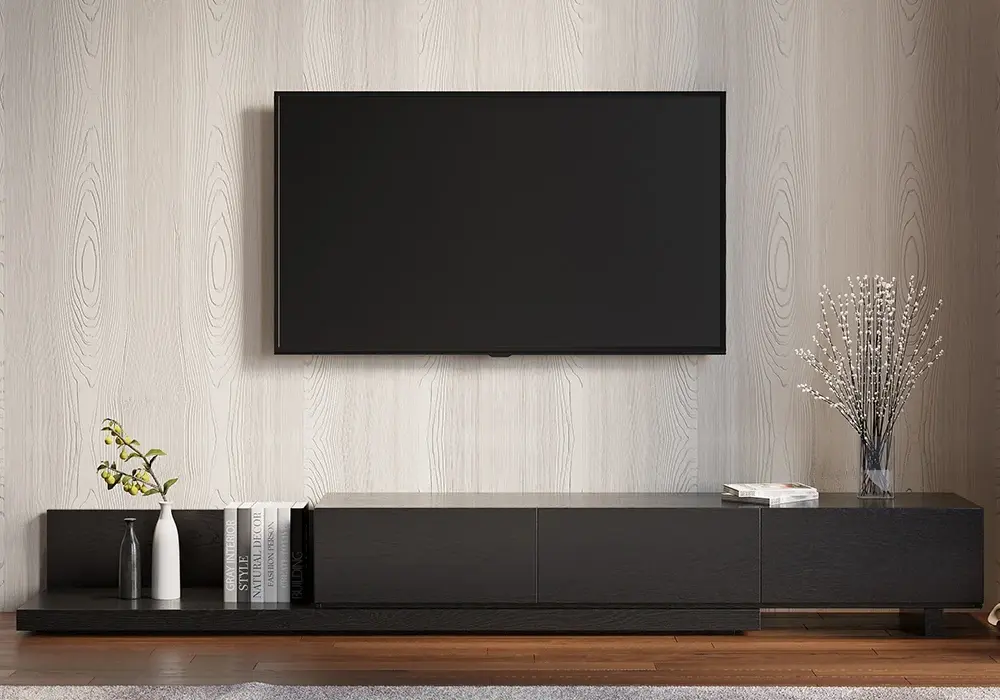
13 in console → 13 in gap. At 84–110 inches wide, the Kayla is the lowest of the three, which leaves the most room beneath the screen. It suits a setup with a soundbar plus a game console or streaming box, or a lower screen position.
Velar extendable fluted TV stand with sintered-stone top: 14 in tall
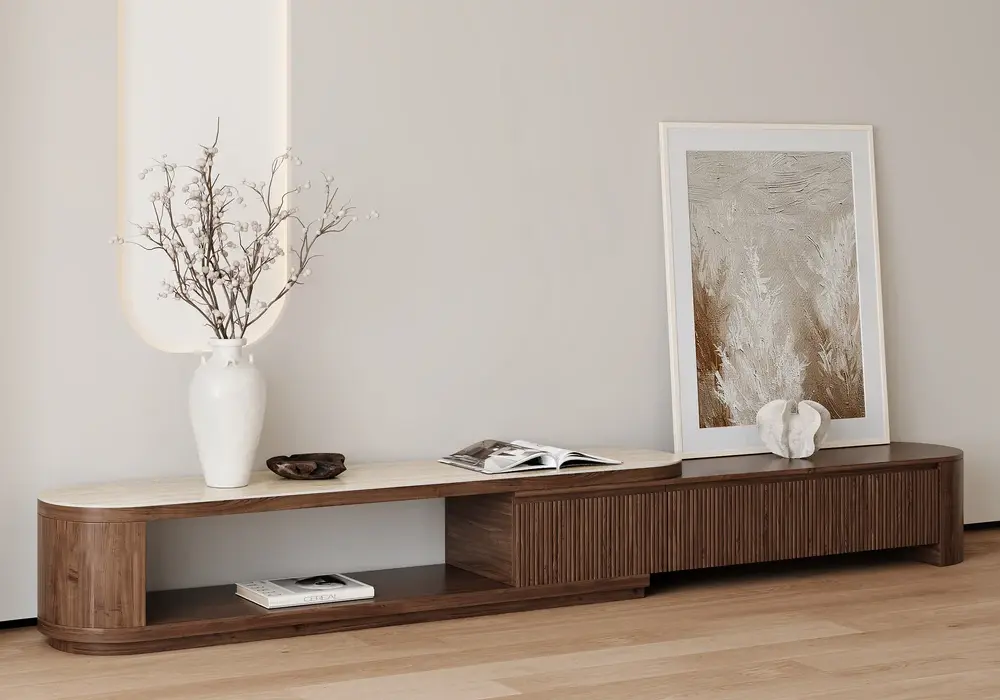
14 in console → 12 in gap. The Velar extends from 71 to 114 inches. A 12-inch gap fits a soundbar with space to spare, and the sintered-stone top works well with a few low decor pieces.
Quoint 71–100-inch extendable TV stand: 16 in tall
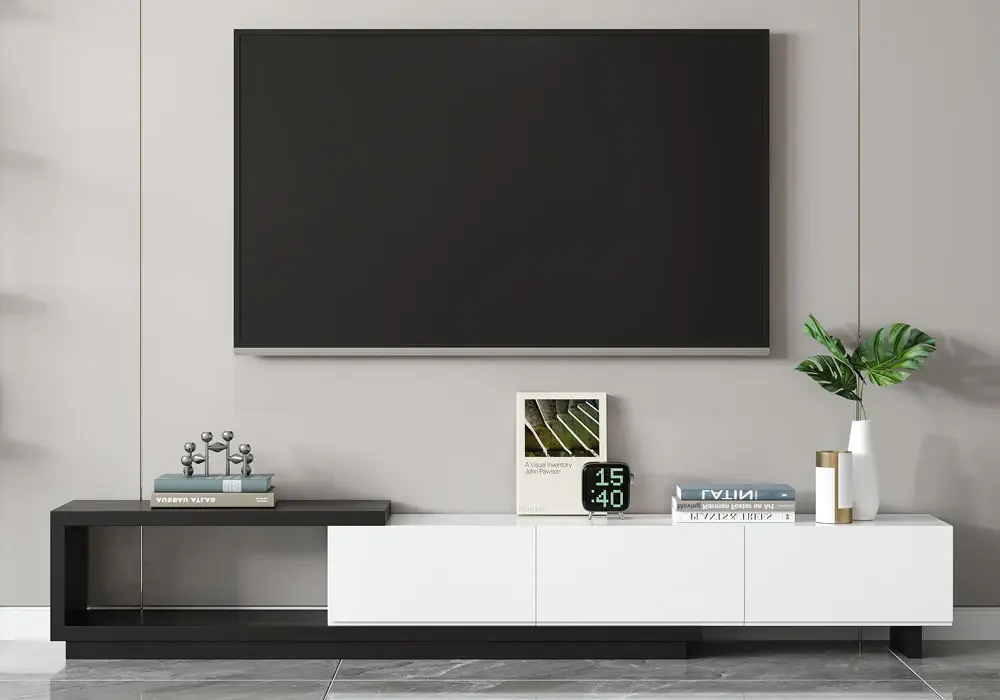
16 in console → 10 in gap. The Quoint is the tallest of the three and gives the tightest, most connected look. It fits a setup without a soundbar, or a larger TV whose bottom edge sits lower.
Quick comparison
Console | Height | Gap under a 26 in bottom edge | Best for |
Kayla | 13 in | 13 in | Soundbar plus equipment underneath |
Velar | 14 in | 12 in | Soundbar with room to spare, styled top |
Quoint | 16 in | 10 in | No soundbar, or a larger TV |
How to choose:
- Using a soundbar? Most soundbars are 2–3 inches tall and look best with 2–3 inches of space above them. The Kayla and Velar gaps fit that comfortably.
- No soundbar and a big screen? A bigger TV pushes the bottom edge lower and tightens the gap, so the Quoint's 16-inch height still lands close to the 4–8 inch sweet spot.
- Low ceiling or short wall? Pick the lowest console so the TV can stay at eye level without crowding the room.
All three units extend in length, which changes how wide the console looks next to the TV. It does not change eye level, so always calculate the screen position first and the console second.
Soundbars, remotes, and ventilation
Place the soundbar in the mockup before you drill. It should sit below the picture without blocking the bottom edge or the TV's remote receiver. Keep tall vases and lamps out of the screen outline, and use low pieces such as a bowl or a short stack of books on the console top.
Wall, mount, and glare
The bottom edge of the screen is not where the drill goes. Mounting holes sit above or below the TV's center, so give the installer your finished bottom-edge height and let the mount template set the hardware position. Use a VESA-compatible mount rated for the TV's weight, and check the wall construction. Sony's TV wall mount FAQ recommends a wall that can hold four times the TV's weight.
If you see window or lamp glare, try curtains or a tilt mount before you move the TV higher.
Final check
Review the outline from every main seat: sofa, recliner, side chair. Photograph it for proportions, but judge comfort while seated. Write down the approved bottom-edge height and use that single number for the installer.
Frequently Asked Questions
What is the ideal gap between a TV and a media console?
About 4–8 inches without a soundbar and 6–10 inches with one. Calculate it with: screen-center height − half the TV height − console top height.
Should the center of the TV be at eye level?
Yes, for seated viewing. Sony recommends the center of the screen at eye level, which is about 42 inches from the floor for most living rooms.
How high should a TV be mounted above a soundbar?
Leave about 2–3 inches between the soundbar and the bottom of the TV, and keep the soundbar from covering the TV's remote sensor.
Does the size of the TV change the gap?
Yes. A taller TV with the same center height has a lower bottom edge, so the gap shrinks. A 65-inch TV (about 32 inches tall) leaves less space than a 55-inch TV (about 27 inches tall).
How high should I mount a TV in the bedroom?
Lower than the living room. When you watch lying down or propped on pillows, set the screen center at the eye level of that position, usually 36–40 inches from the floor.
How high above a fireplace can a TV be mounted?
Often higher than ideal. If the TV must go above a mantel, use a tilting or pull-down mount and sit-test the position first. Follow the TV and fireplace manufacturers' heat guidance.
What happens if I mount the TV too high?
You tilt your head back, which strains your neck during long viewing sessions and can reduce picture quality at off-axis angles.
Does an extendable TV stand change the right TV height?
No. Extending the console changes its width, not your eye level. Its top height decides the gap, so calculate from that number.
Where should the installer measure the mounting height?
From the floor to the finished bottom edge or the screen center. They will convert it to the bracket position using your TV and mount template.