

A wall reclining sofa uses a space-saving movement intended to let its seats recline nearer a wall than a design that swings mainly backward. In many wall-hugging mechanisms, the seat moves forward as the back reclines. When comparing power reclining sofas, look for models that state their zero-wall design outright and list their reclined depth, so you can plan the room with real numbers. "Wall reclining" does not mean the sofa attaches to the wall, and "zero wall" should not be interpreted as permission to leave an unverified zero-inch gap.
The feature can help when you want reclining seats along the edge of a room. It does not eliminate the space needed in front for footrests, beside the furniture for controls, or around the seating for people to move. A useful assessment considers the whole arrangement in operation.
Start by identifying the mechanism, then measure the room and the documented furniture positions. That sequence is more reliable than choosing a sofa because it appears close to a wall in a product photograph.
Table of Content
How Wall-Saving Reclining Differs From Backward Reclining
A conventional reclining arrangement can require space behind the back as it changes angle. A wall-saving design changes the movement path to reduce that rearward demand, often by carrying the seat forward during recline.
Ask whether the drawing shows the upright outline, the fully reclined outline, and the required distance from the wall. Also establish whether a headrest or another adjustable section moves beyond those outlines. A single overall-depth measurement cannot answer every placement question.
Do not assume all seats follow the same arrangement. A sofa may have powered outer seats, fixed sections, or different modules. The seating and control diagrams should identify which positions move and how the mechanism relates to the complete piece.
Understand Wall-Hugger, Zero-Wall, and Power Terminology
Wall-hugger and wall-saving are commonly used descriptions of the placement benefit. Zero-wall is another marketing term, but its meaning must be interpreted through the product's documented requirements. None of those words supplies a universal dimension.
Power reclining describes the operating method: a motor changes the relevant seating position. It does not by itself establish that the mechanism saves rear space. A powered recliner can still need clearance behind it, while a wall-saving design may have a particular approved control arrangement.
Zero-gravity terminology describes a reclining position or feature rather than the sofa's required distance from the wall. A product may combine both ideas, but they answer different questions. One concerns the seating position; the other concerns movement and placement.
Keep those questions separate when comparing options. First establish whether the sofa offers the position you want. Then check whether its operating outline fits the room. A desirable position is less useful when reaching it obstructs the room's only practical route.
Two Zero-Wall Sofas to Consider, in 2-Seater and 3-Seater Sizes
The clearest sign of a wall-saving sofa is a plain statement of it in the product description. Both sofas below make that claim, and both come in 2-seater and 3-seater versions, so you can match the size to your wall. The dimensions listed here are for the 2-seater.
Genuine-Leather-Contact Power Reclining Sofa with Swan-Neck Arms
The genuine-leather-contact power reclining sofa with zero-wall functionality pairs a tailored, modern look with dual zero-wall recliners. Both recliners extend fully in tighter spaces without hitting the wall.
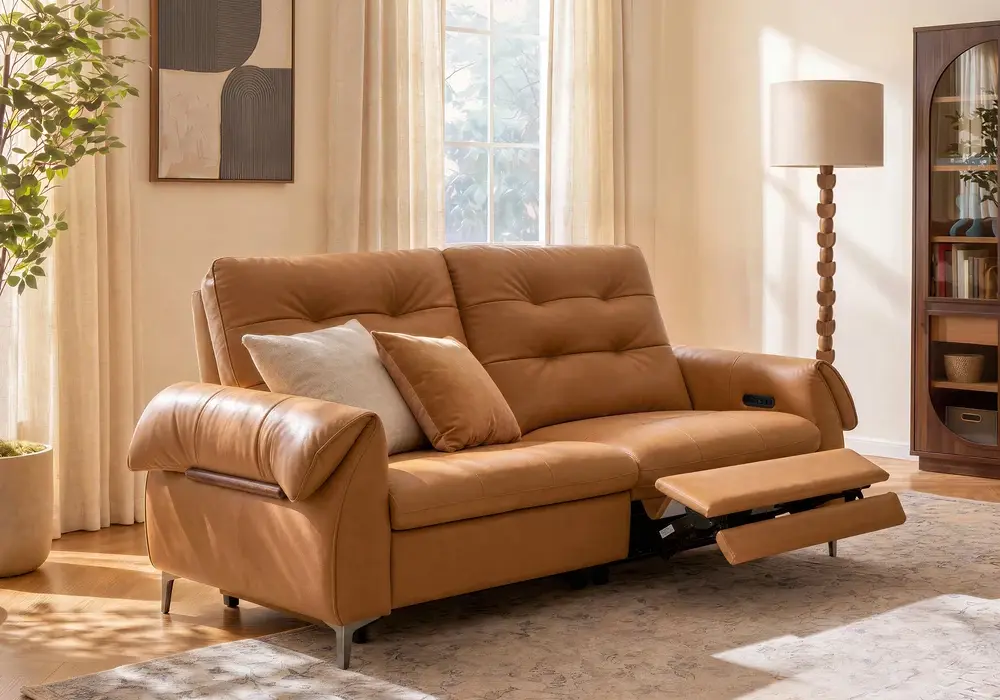
- Design: Swan-neck arms and precise tufted stitching give it a refined, high-design shape.
- Upholstery: Genuine leather on the contact areas is paired with durable faux leather on the sides, for comfort with easy care.
- Convenience: Built-in USB and USB-C charging ports keep phones and tablets powered while you recline.
- Comfort: High-resilience foam cushions hold up to movie nights and daily lounging.
It suits living rooms where the sofa sits along a wall and you want a polished, leather-forward look with charging built in.
89-Inch Chenille "Triple-Zero" Power Reclining Sofa
The Softplume chenille power reclining sofa takes a softer, more textured approach. Its "Triple-Zero" design combines zero gravity, zero wall and zero gap in one piece, so it can recline fully without moving away from the wall.
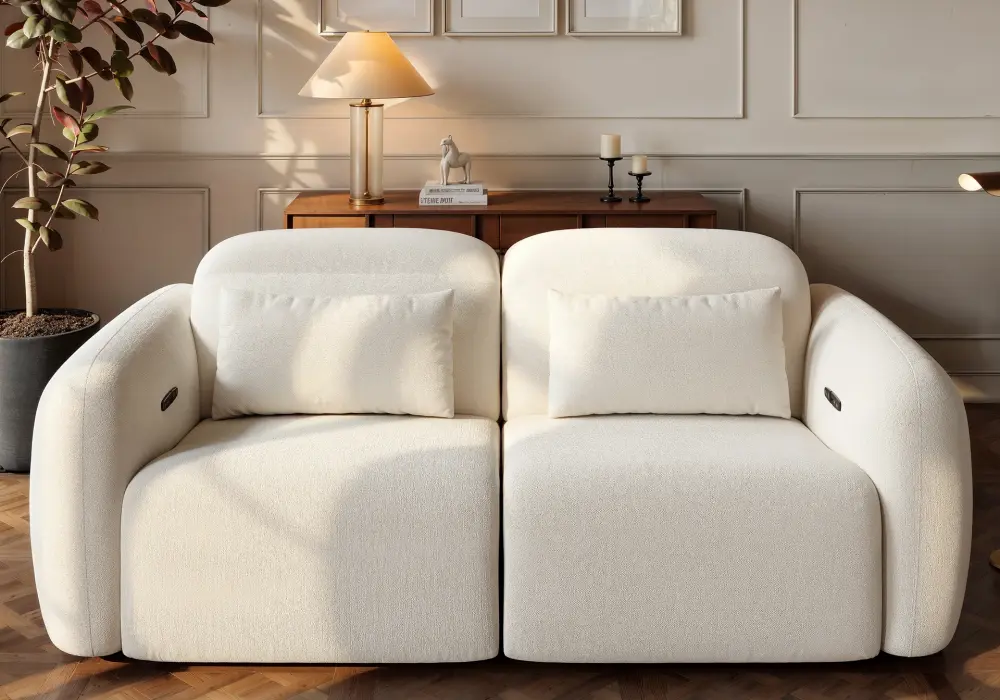
- Power reclining: The dual-motor mechanism offers smooth one-touch adjustment to find your position.
- Zero-gravity seating: Elevated legs and balanced support give a relaxed, supported recline.
- Upholstery: Plush chenille adds rich texture and is practical for everyday care.
- Comfort: Generous seating and layered cushioning make for lasting comfort.
It suits those who want a softer fabric look and the zero-gravity position in the same sofa.
Which One Fits Your Space?
Choose the leather-contact model for a structured look and built-in charging. Choose the chenille model for soft texture and zero-gravity comfort. Either way, pick the 2-seater for apartments and compact living rooms, or the 3-seater for family seating along a longer wall.
Measure the Rear Gap From the Relevant Surfaces
Begin with the actual wall area where the sofa will stand. Include baseboards, wall-mounted objects, curtains, outlets, and anything else that projects into the movement space. The floor-level gap and the gap near a moving back can be different.
Follow the manufacturer's defined measurement points. A stated clearance might relate to an upright reference, a fully reclined position, or a particular part of the back. Do not substitute the nearest convenient point and assume the result means the same thing.
Mark the upright and operating outlines on a simple room plan. If the documentation is ambiguous, ask for clarification before placing the furniture tightly against the wall. Keep the confirmed measurement with the order and setup information.
Remember that electrical connections need an appropriate route too. Follow the sofa's instructions for supply placement and cable routing. A narrow rear area is not a suitable place to pinch a plug or cable simply to preserve a visually flush arrangement.
Plan the Front as Carefully as the Back
A forward-moving mechanism still occupies floor space when it opens. Check the footrest's complete extension against the coffee table, rug, and nearby objects.
Mark where the table would sit and test whether the remaining surface is useful from the seat. If the table must move so far away that it no longer serves drinks or reading, side tables may be a more practical arrangement.
Consider the route out of the seating group. Someone should not have to plan every ordinary movement around a footrest crossing an essential doorway or passage. Assess the positions the household will actually use together, including adjacent seats.
A simple hypothetical comparison illustrates the tradeoff: reducing the space behind a sofa does not help if its open footrest blocks the only route to the room exit. The complete operating layout, rather than the rear gap alone, decides whether the feature benefits the room.
Use a Checklist to Compare the Complete Setup
Question | Information to obtain | What the label alone cannot establish |
Does it save rear space? | Explicit mechanism description and placement drawing | Whether ordinary power reclining is wall-saving |
How close can it sit? | Model-specific clearance and measurement points | A universal zero-inch or other fixed gap |
What moves forward? | Upright and operating outlines | The complete front footprint |
Which seats recline? | Seating and control diagram | Independent movement from cushion count |
Can the room remain usable? | Furniture positions and everyday routes | Whether a small rear gap means a small overall layout |
How is it connected? | Supply and cable-routing instructions | An approved electrical arrangement behind the sofa |
Use the checklist before comparing decorative details. A sofa that fits the planned location and supports the desired activities is a stronger candidate than one whose attractive feature label leaves essential measurements unresolved.
Once the practical requirements are confirmed, compare the upholstery, shape, and finish in the context of the room. Wall-saving movement is one selection criterion, rather than a substitute for the rest of the seating brief.
Check Comfort and Controls Independently
Sit in the position you expect to use most, with the intended cushions in place. Consider seat depth, back support, headrest position, and the reach to the controls. A space-saving mechanism does not guarantee that those proportions suit every user.
Review the control diagram rather than guessing how a button behaves. Different products can use different combinations of linked movement, separate adjustments, or documented return functions. Do not infer a control sequence from the number of visible buttons.
Consider other users and visitors. A shared sofa benefits from controls that people can identify and operate according to the instructions. Keep loose accessories arranged so the panel and movement areas remain accessible.
For television viewing, assess the screen from the reclining position as well as upright. The room may need changes to table or lighting placement even when the sofa's wall relationship works. Evaluate the experience as a complete seating arrangement.
Frequently Asked Questions
Does a wall reclining sofa attach to the wall?
The term describes the sofa's reclining movement and placement, rather than wall attachment. Follow the product's installation and operating instructions. Do not confuse a wall-saving mechanism with a wall-mounted sofa or assume the wall supports its reclining movement.
Can a zero-wall sofa touch the wall?
Only use the placement explicitly permitted for the exact model. Zero-wall wording does not supply a measurement, and nearby baseboards, curtains, headrests, and electrical connections may affect the arrangement. Obtain the clearance drawing before planning a flush position.
Is every power recliner a wall recliner?
No. Power describes motor-operated adjustment, while wall reclining concerns the movement path and rear-space requirement. Look for an explicit feature description and confirm it with the model's placement information rather than inferring it from powered controls.
Does a wall recliner need less space in front?
Do not assume so. Footrests and forward-moving sections still need their documented operating area. Measure the complete outline and check tables and circulation. Saving rear space can be useful without reducing every other dimension of the layout.
Is zero gravity the same as zero wall?
No. Zero-gravity wording concerns a reclining position or feature; zero-wall wording concerns space near the wall. A sofa may advertise both, but each needs its own verification. Neither term establishes a medical benefit or a universal comfort setting.