

How to decorate a glass coffee table is a question with two halves, and most guides only answer the first. The styling half is familiar: layer objects of different heights, keeping a limited palette, and leaving the surface partly visible. The other half is protecting the glass, and it matters more on a glass table than on any other surface because every mark shows.
The single most useful principle is this: glass shows everything and holds nothing. It reflects light and every fingerprint, watermark, scratch, and ring mark. So the right approach is to protect the glass first with a base layer, then style on top of that layer. Start with the surface, because it determines how much protection your arrangement needs.
Table of Contents
Protect the Glass Before You Style It
A glass coffee table lives or dies by what you place directly on it. The good news is that a few cheap habits eliminate almost all damage.
Use felt or rubber pads under every object that touches the glass. This is the highest-value, lowest-cost step. Stone bases, ceramic vessels, metal candle holders, and wooden objects all leave scratch marks or dents when they sit directly on glass. A self-adhesive felt pad under each one costs pennies and prevents the problem entirely.
Place a protective layer across a working area. If part of the table is used for laptop work, drinks, or writing, cover that section with a leather blotter, a cork mat, a placemat, or a large tray. This creates a defined, protected zone and doubles as a styling element that anchors the arrangement.
Never drag objects across the surface. Lift and place. A dragged coaster or a slid book leaves a scratch that no polish will fully remove.
Keep grit away. Glass is far more vulnerable to sand and grit than most people expect. Sweep the floor and vacuum the area around the table regularly, and wipe the tabletop rather than sweeping grit across it.
Clean with a soft, lint-free cloth. A microfibre cloth with a mild glass cleaner or plain water and a drop of dish soap works. Avoid abrasive pads, and avoid ammonia-based cleaners on any surface with a coating or an applied finish.
Be careful with hot and sharp objects. A hot mug can leave a ring or a dull spot on glass. A sharp corner pressed down can chip it. Both are avoidable by using coasters and trivets as a matter of habit.
Understand Why Marks Appear
Different finishes behave differently, and knowing why a mark appears tells you how to treat it.
Tempered glass is the standard for coffee table tops because it is heat-treated to be far stronger than ordinary glass, and it breaks into small pieces rather than shards if it does fail. It still scratches, and those scratches are permanent. Most coffee table glass is tempered, but confirm with the product specifications.
Lacquered or painted wood can be marked by rings and scuffs more readily than glass, because the finish is softer than tempered glass. A clear felt mat protects it well.
Clear acrylic scratches easily and shows every fingerprint. Treat it with the same caution as glass, and expect a polishing cloth to be useful.
Style on a Layer, Not on the Bare Glass
The most effective glass table arrangements have a visible base layer. This solves the protection problem and improves the styling at the same time.
A large tray works as a base for a group. On a round table, choose a tray roughly half the table's width; on a rectangular table, roughly two-thirds of its length. Centre it, and build a small arrangement on top. The tray's rim protects the glass under the whole cluster, and the tray's own shape frames the objects.
A runner or mat running the length of a rectangular table defines a corridor of protected surface and creates a linear composition that suits the table's shape.
Two or three individual mats under separate object groups is a subtler approach. It keeps the glass visible between the groups while protecting the places where things actually sit.
A mirrored or lacquered base adds depth to a glass table because you see the arrangement reflected. Use a flat, non-glazed base and keep the objects on it low, since tall objects reflect awkwardly. On a plain tray or mat, you can use more height, as described below.
Build Height and Scale
Once the surface is protected, the styling follows the same principles as any coffee table, with a few adjustments for glass.
Glass rewards vertical objects. Because the surface is visually thin and reflective, an object with height reads more strongly on glass than the same object on an opaque table. A tall vase, a sculptural candle, or a stack of books standing upright will look better on glass than on a solid wood top. Place the tall piece within a group, anchored by lower objects, rather than alone.
Keep the composition light. Glass already reads as visually light because you can see the floor through it. A heavy, dense arrangement fights that and makes the table feel heavy in the room. Opt for fewer objects with more air between them.
Use fewer, larger objects. Because the glass shows the surface beneath, small scattered items create visual noise on the table and in the room. Three considered objects will look better than eight small ones.
Make the underside part of the design. With glass, the frame, base, and what is beneath the table all become visible. Choose objects that look good from a seated and standing position, and check that the base design is not hidden by a large rug or a low sofa.
Use colour to your advantage. The transparency of glass means anything colourful placed on it appears more saturated than it would on an opaque surface. A single object in a strong colour has more impact on glass than on wood.
Choose the Right Objects for a Glass Surface
Some objects work far better on glass than others.
Works beautifully: glass and crystal objects, which layer transparency on transparency; ceramic in a strong colour, which pops against the neutral surface; natural materials like rattan, woven fibres, and unfinished wood, which add warmth against the cool surface (set them on a tray or felt pad); candles, which reflect; and books laid flat, which give a stable base for smaller objects.
Use with care: anything with a rough, unfinished, or unsealed base, which will scratch unless padded; metal with a sharp or thin base; and thick ceramic bases that can be heavy enough to be awkward to move.
Avoid entirely: a glass of water left directly on the surface, which will ring; sharp-edged objects resting at an angle with their point bearing weight; and anything left steaming-hot without a trivet.
Match the Style to the Table's Own Design
A glass coffee table's frame, base, and finish already define its character. The decor should support that rather than compete with it.
A table with a strong sculptural base needs almost nothing on top. The base is the statement, and a single object in the centre or a small tray will let the design read. Filling the top of such a table hides the feature you paid for.
A table with a delicate, minimal frame calls for a bolder arrangement. Thin glass tops with slender metal frames look lost with a single candle; they need a grouping with enough presence to balance the delicacy.
A table with a warm wood frame and a glass top wants cool or neutral objects on it. The contrast between the warm frame and cool top is the table's main visual interest, and warm objects on top blur it.
Table Options and Their Styling Potential
Two tables show how the surface and base change the way you decorate. The first is a true glass top, and the second shows how the same habits apply to a dark matte surface.
A Round Glass Table with Ash Wood Legs
The 32" Round Glass Top Ash Wood Legs Coffee Table pairs a tempered glass top with a turned solid ash wood frame that wraps around the edge of the glass. It measures 32 inches wide, 32 inches deep and 16 inches high, with a weight capacity of 55.1 pounds.
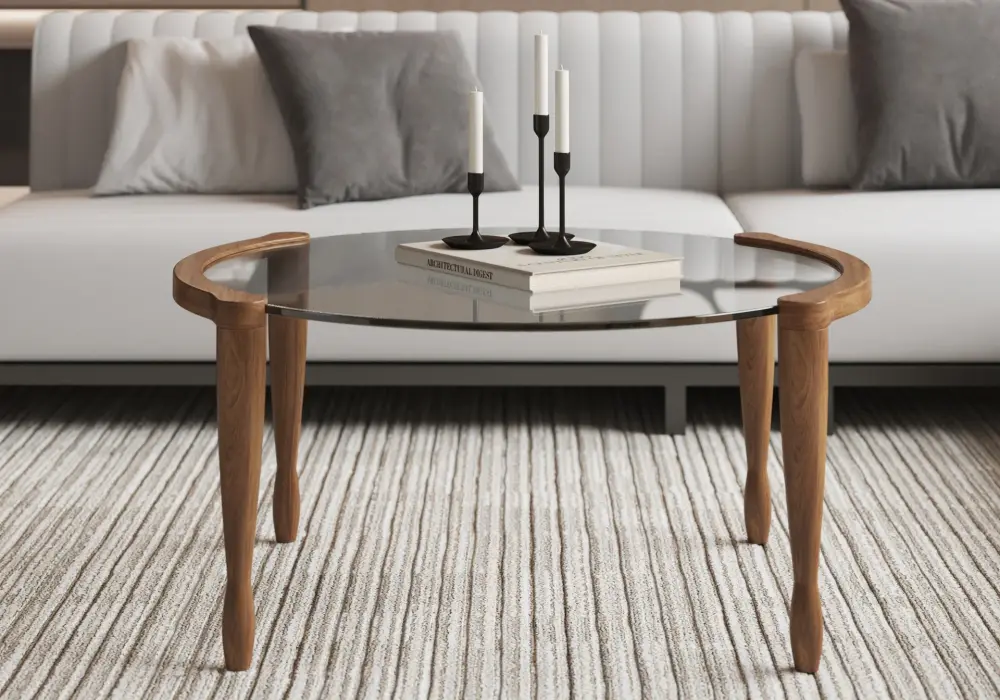
This is the table the "protect first, style second" rule was written for. Three things shape how to decorate it:
- Mind the weight limit. 55.1 pounds is generous for decor but not for a stack of large art books plus a stone tray plus a vase. Keep the arrangement light, and put heavier items on a shelf or a side table.
- Use a round tray about half the table's width. A 14 to 16 inch tray with felt pads underneath protects the centre of the glass and gives a small grouping a clear frame, while the glass and the ash frame stay visible around it.
- Choose cool or neutral objects. The warm wood frame against the cool glass is the table's main feature. A glass vase, a white or colored ceramic piece, and a single candle on the tray keep that contrast clear.
At 16 inches high, the table is low, and you will mostly look down onto it from a sofa. That makes height a good tool here: one tall stem or sculptural object on the tray, anchored by a lower piece or two, reads well, while low scattered items add visual noise. Because the top is round, group objects in a loose triangle rather than a straight line, and leave the outer ring of glass clear. Wipe it with a microfibre cloth and glass cleaner to keep it clear.
A Black Fluted Round Table with Storage
The 32-Inch Fluted Lift-Top Round Coffee Table with 2 Drawers in Black is 32 inches wide, 32 inches deep and 23 inches high, with a black fluted base, an engineered wood top, two drawers and a hidden compartment under the lift top.
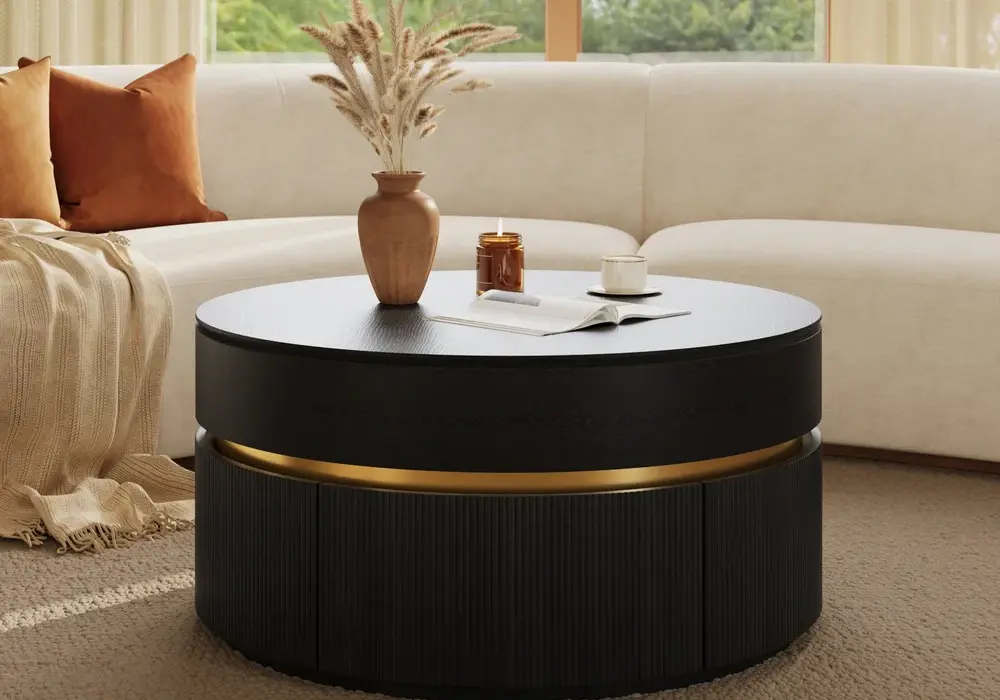
The top is engineered wood rather than glass, but the lesson carries over. A matte black surface shows dust, fingerprints and water rings as readily as glass. The deep fluting is the feature, so keep the top low and sparse. Use the drawers and the concealed compartment for remotes, coasters and everyday clutter, which is the easiest way to keep any coffee table looking clean.
The Mistakes That Damage or Flatten a Glass Table
Letting objects sit directly on the glass. No pads, no protection, and eventually a scratch that stays.
Displaying nothing. An empty glass table can look intentional, but more often it looks like the money was spent on the table and not enough on the room. One or two well-chosen objects change the read entirely.
Overfilling it. Glass already feels airy. Filling the surface removes that quality and makes the room feel cluttered rather than open.
Ignoring what is underneath. On glass you see the floor, the rug, and the base. Check how the table looks from a seated position, where the sightline runs through the top to the floor beyond.
Placing one lone object in the centre. A single object alone in the middle of a round table reads as a placeholder rather than a composition. Group two or three objects of different heights instead.
Leaving wet glasses. Rings and watermarks are the single most common mark on a glass top, and they are entirely preventable with coasters.
Frequently Asked Questions
How do you decorate a glass coffee table without scratching it?
Put felt or rubber pads under every object that touches the surface, and lift items rather than sliding them. Use a tray or blotter over any area you use actively.
What should not be put on a glass coffee table?
Avoid objects with rough or unfinished bases, sharp-edged items resting at an angle, and anything hot or wet without a coaster or trivet.
Should you put a tablecloth on a glass coffee table?
Rarely. A cloth hides the glass itself, so a tray, blotter, or runner over part of the surface protects it while keeping the glass visible.
Does glass show fingerprints more than other surfaces?
Yes. Skin oils show up clearly when light rakes across the surface, so wipe it regularly with a microfibre cloth.
Is a glass coffee table harder to decorate than a wooden one?
Somewhat, because glass shows every mark and makes clutter look worse. With a protective base layer and a light composition, it is no harder.
What kind of tray works on a glass coffee table?
A flat-based tray with raised edges, sized to roughly half the table’s width on a round table or two-thirds of its length on a rectangular one. Add felt pads under its contact points.
Can you put candles on a glass coffee table?
Yes, in a holder or glass hurricane on a drip tray, kept away from the table’s edge, fabric, and paper. Never leave a burning candle unattended.
How do you clean a glass coffee table?
Wipe with a microfibre cloth and plain water with a drop of dish soap, or a glass cleaner. Avoid abrasive pads, and clean spills promptly.